
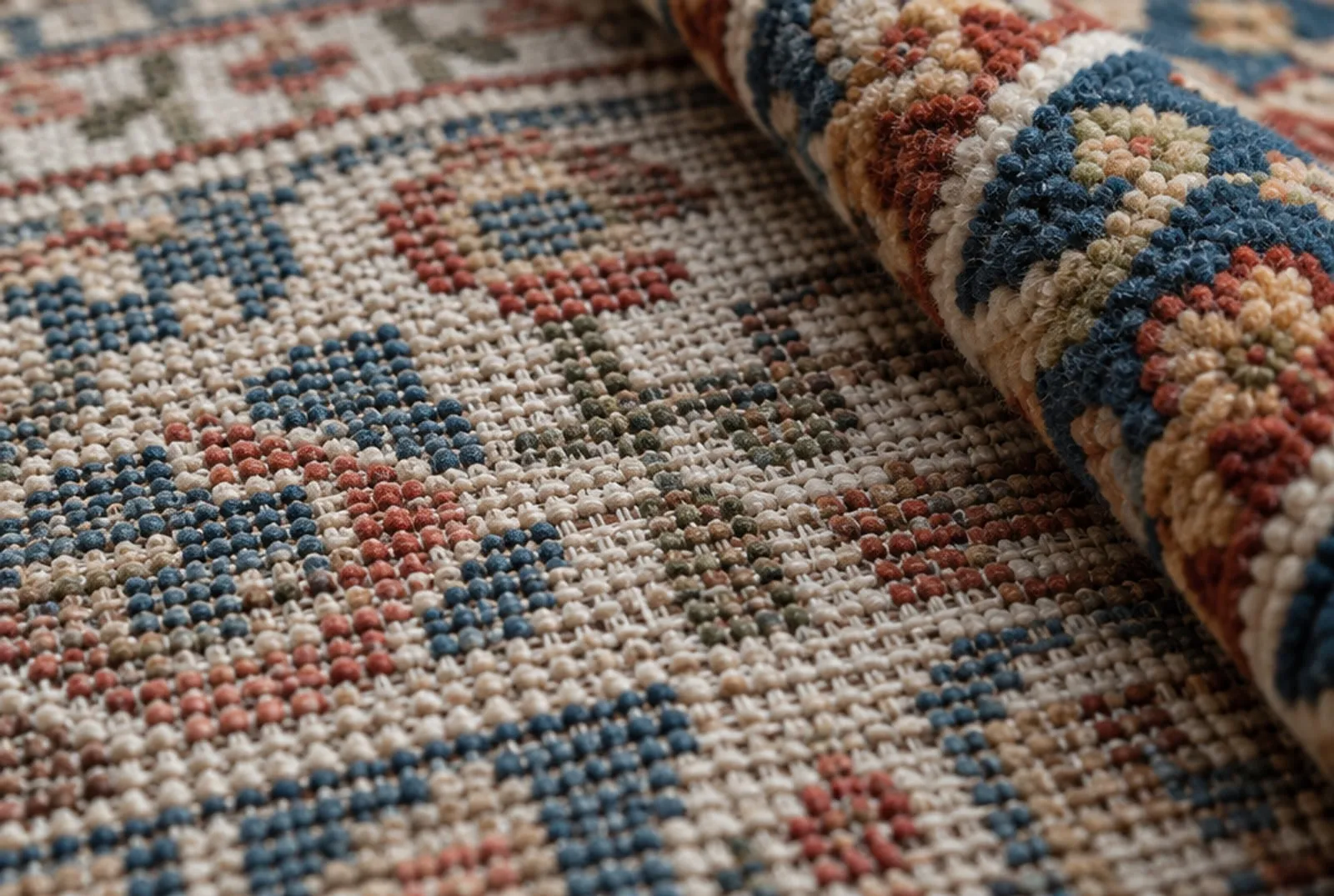
Hand-knotted: the pattern goes all the way through
On a hand-knotted rug the design is clearly visible from the back, because the pattern is the knots themselves rather than something printed or punched on top. Look closely and the knots are slightly irregular — that irregularity is the sign of a hand.
The fringe is also part of the structure: it is the warp threads the rug is built on, emerging at each end. It has not been sewn on, and it cannot be removed without unmaking the rug.
These are the rugs that most reward a proper in-plant wash, and the ones where the wrong method is most expensive. Expect $5–$8 per square foot, or $6–$9 in Manhattan.
Machine-made: uniform back, attached fringe
A machine-made rug has a very even back, often with a visible grid, and any fringe is stitched on as a separate piece. Lift the fringe and you can usually see the seam.
They clean well and cost less, typically $3–$6 per square foot for synthetic fibers. They are also the rugs most likely to be fine with a simpler method.
Tufted: glue and a fabric backing
Turn a tufted rug over and you will find a fabric backing covering everything, usually with a mesh scrim underneath it. The yarn is punched into a backing and held with latex adhesive.
That adhesive is the thing to know about. As it ages it breaks down, and heat or heavy moisture accelerates it — a delaminating tufted rug smells of old glue and sheds. A good cleaner will tell you when a tufted rug is not worth a full wash, and that honesty is worth more than the quote.
Viscose: the one to flag every time
Sold as art silk, bamboo silk or banana silk, viscose looks like silk and behaves like paper. It weakens when wet, marks permanently from plain water, and yellows.
If there is any chance your rug is viscose, say so before anyone quotes. It changes the method entirely, and a cleaner who finds out afterwards has a much harder problem.
A quick test: a damp white cloth pressed on an inconspicuous corner of viscose often picks up colour or leaves the fibers looking crushed and dull.
What to tell the cleaner
With the rug turned over, you can answer nearly everything that affects the price:
- Roughly how it is made: hand-knotted, machine-made or tufted
- The fiber, or your best guess — wool, synthetic, silk, or possibly viscose
- The size, measured rather than estimated
- Any pet accidents, and roughly when and where
- Whether the edges or fringe are damaged, which is priced separately at $3–$10 per linear foot