
Act in the first few hours
Water damage is a timing problem more than anything else. A soaked rug has roughly 24 to 48 hours before mould and a sour smell set in, dyes start to migrate while the fibres are saturated, and clean water turns dirty as it draws soil up out of the foundation. The faster you get the rug out of the water and air moving through it, the more of it you save.
Get the water out
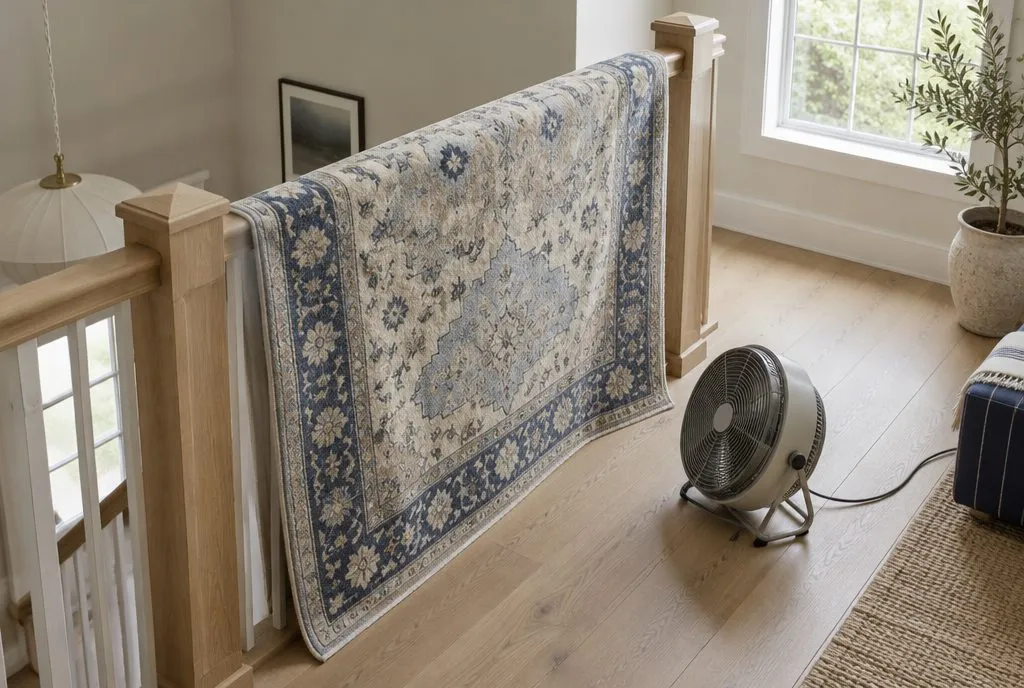
Lift the rug off the wet floor straight away — a rug left on a soaked floor keeps wicking water back up. Press the water out rather than rubbing, which distorts the pile: lay towels over it and walk on them, or use a wet vacuum if you have one. Then get it off the ground and drying: hang it over a railing or lay it flat on blocks, open the windows, and aim fans across both sides. A dehumidifier helps in a closed room.
- Never fold or stack a wet rug — it sets creases and traps damp
- Do not use heat (a hair dryer, radiator or hot sun) — it can set dyes and odour
- Dry both sides; the foundation underneath holds the most water
Clean water or contaminated water?
What the rug got wet with matters as much as how long. Clean water — a burst supply line, an overflowing sink, rain through a window — is the recoverable case, and fast drying often does most of the work. Grey or black water — a sewage backup, a storm flood, a washing-machine overflow — carries bacteria and health risks, and a rug soaked in it often has to be discarded rather than risked. Do not handle contaminated water with bare hands, and do not try to rescue a sewage-soaked rug yourself.
Why a badly soaked rug needs a plant
Drying at home handles a damp rug, but a rug that was truly soaked rarely dries evenly on its own — the foundation stays wet long enough to grow mould and lock in odour, even after the surface feels dry. A cleaning plant flushes out any contamination, washes the rug, and dries it fast under controlled airflow and temperature on racks or in a centrifuge, which is what actually stops the smell and mould coming back. If the rug is wool, hand-knotted, antique or sewage-exposed, get it to a plant quickly rather than gambling on a fan.
Can it be saved — and will insurance pay?
Whether a rug comes back depends on the water, the soak time and the rug itself: clean water and fast action give the best odds, while prolonged soaking, contaminated water, unstable dyes, shrinkage or a rotted foundation can push a rug past saving. Ask a cleaner for an honest assessment rather than a hopeful one. For an insurance claim, photograph both sides of the rug before anything is moved and ask the cleaner for a written condition report — that paperwork, filed early, is usually what a homeowner or renter policy needs.