
PureGreen Carpet and Rug Cleaning
- Area rug cleaning
- Oriental and Persian rug cleaning
- Rug repair
- Carpet cleaning
Queens · Jackson Heights
Jackson Heights was built as an experiment. Between 1914 and 1939 the Queensboro Corporation put up five- and six-storey apartment buildings arranged around private interior gardens — the first garden apartments in America, and among the first co-ops in the country. Over two hundred of those original buildings are still standing, and roughly six hundred sit inside the historic district designated in 1993, between 76th and 88th Streets from Roosevelt Avenue up to Northern Boulevard.
These companies list Queens in their service area. Confirm they cover your Jackson Heights address when you call.
Ratings are each platform’s own figures, linked to the listing. Details come from each company’s website; RugRate has not yet verified these companies.
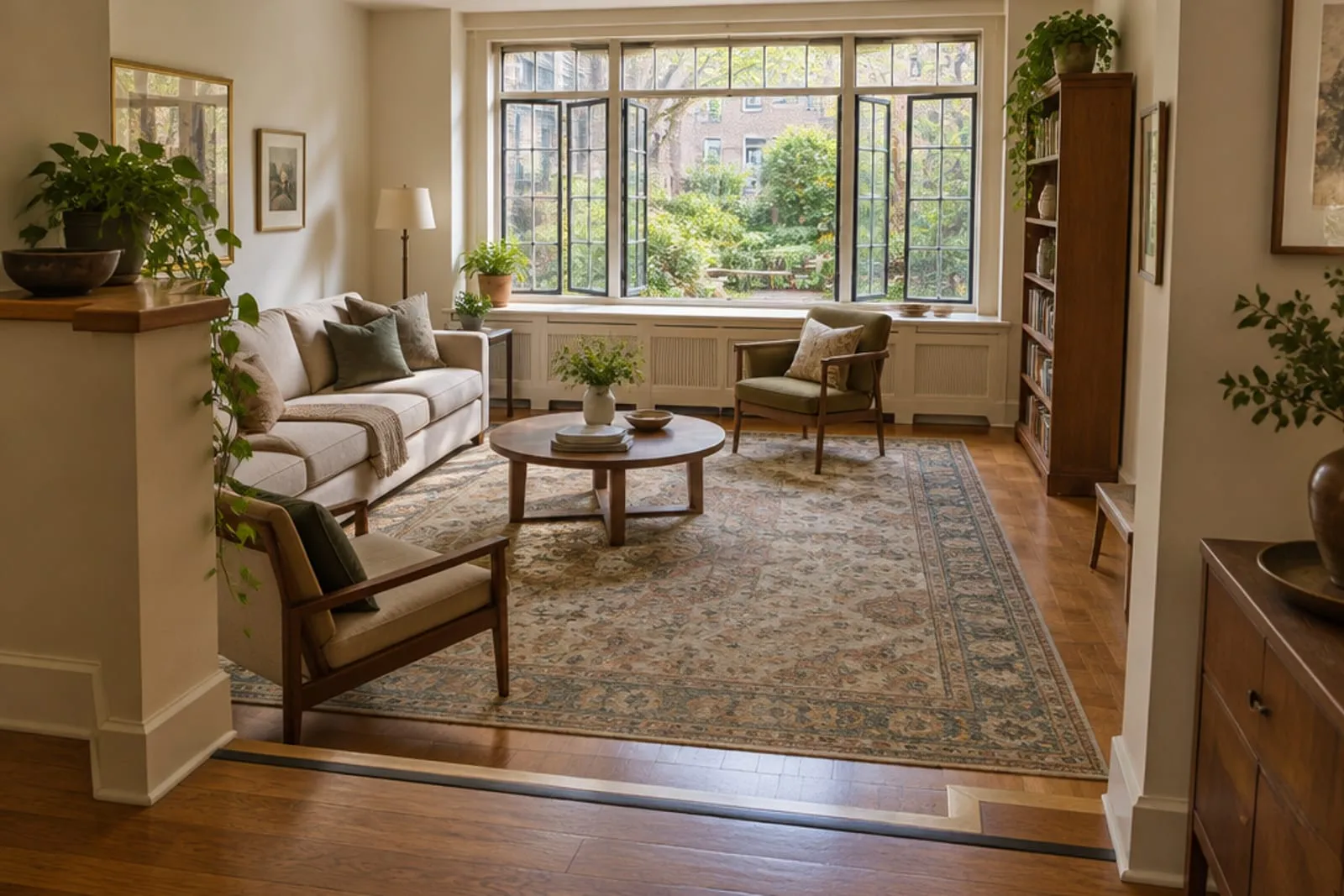
Those buildings are wonderful to live in and awkward to get a rug out of. They have steam radiators, original windows, narrow service stairs and, in most cases, no doorman, no package room and no staff member who can take delivery of a nine-by-twelve wool rug on a Tuesday afternoon. Two problems follow from that, and this page is about both of them.
If you already know what you need, compare cleaners serving 11372 below and get quotes. If you want to know what the black lines along your baseboard are, that section is further down, and the answer is more interesting than "dirt."
Jackson Heights sits in the standard Queens range. Prices below are per square foot for in-plant washing, which is what most rugs here need.
| Rug type | Price per sq ft | 8×10 rug (80 sq ft) | 9×12 rug (108 sq ft) |
|---|---|---|---|
| Synthetic (polypropylene, nylon) | $3–6 | $240–480 | $324–648 |
| Wool | $4–7 | $320–560 | $432–756 |
| Persian / Oriental hand-knotted | $5–8 | $400–640 | $540–864 |
| Silk or silk-blend | $6–10 | $480–800 | $648–1,080 |
Almost every cleaner in the city applies a minimum service charge of $150–250 per pickup. On a small rug that minimum, not the square footage, is the price you pay — a 3×5 runner is not going to cost forty dollars. If you have several rugs, send them together and clear the minimum once.
Add-ons you may see quoted: pet-odour treatment, moth treatment at $20–50 per rug, binding or serging repair at $3–10 per linear foot, and storage at $20–60 per month.
Look at the edge of a rug where it meets the wall, or the carpet just inside a door that stays shut, or the line where a radiator sits. In a pre-war building you will very often find a dark grey or near-black band, an inch or two wide, running dead straight along the edge. It looks like the vacuum has been missing that strip for years. It has not.
Wherever air is being pushed through or across it — under a closed door, along a baseboard where warm air rises off a radiator and meets the cold surface of an old window wall, around the edge of an area rug on a bare floor — the fibre catches the very fine particles the air is carrying and lets the air through. Over months and years, those particles build up in a line that traces exactly where the air moves.
They are ultrafine carbon: soot from cooking, from candles, from combustion heating, and from street traffic drawn in around a hundred-year-old window frame. Jackson Heights has all four. Roosevelt Avenue and Northern Boulevard carry heavy traffic, the buildings are steam-heated with strong convection currents up the walls, and the original windows were not built to be airtight.
The phenomenon is best documented in buildings with forced-air heating, where the pressure differences are largest. But the physics does not require a furnace — it requires air moving across fibre, and a pre-war building with radiators, gappy windows and closed interior doors produces exactly that.
Filtration particles are not loose. They are extremely fine, often slightly oily, and they are lodged at the base of the fibre where the airflow drove them. Suction cannot reach them, and a standard hot-water extraction pass mostly runs over the top of them.
It is not worn out. It is marked in a very specific place by a very specific mechanism.
Improvement, usually. Elimination, sometimes, and nobody should promise it up front. Removing filtration lines takes a targeted solvent or dry-side treatment applied to the affected band, agitation into the base of the pile, and dwell time — it is a separate operation from washing the rug, and a cleaner who knows what they are doing will price it separately and tell you the likely ceiling before they start.
Be suspicious of anyone who guarantees complete removal on the phone without seeing it. The realistic range is a large visible improvement on a moderate line and a partial one on a line that has been building for a decade. A cleaner who tells you that is a cleaner worth using.
You cannot stop it entirely in an old building, but you can slow it down a lot
Ventilate when you cook, especially anything fried or seared. Burn fewer candles — they are a much larger soot source than people expect. Change any air filter you have on schedule.
A draught stopper under a door that stays shut removes the airflow that makes the line under it. Weatherstripping an old window does the same for the wall line.
Rotating a rug 180 degrees once a year spreads both the wear and the edge exposure, and stops one edge doing all the filtering.
A pad lifts the rug slightly off a bare floor and changes the airflow at the edge, as well as doing its main job of stopping slip and abrasion.
This is the practical half, and it is where most Jackson Heights rug jobs actually go wrong.
A Manhattan co-op on Park Avenue has staff who accept deliveries, a service entrance, a freight elevator with reserved hours and a managing agent who wants a certificate of insurance on file. A Jackson Heights garden co-op typically has a volunteer board, a part-time super, a single narrow stair, a vestibule with a buzzer, and nobody at all between about 3pm and the following morning.
That is not worse. It is just completely different, and it means the burden of arranging access falls on you rather than on the building.
Practically
There is no front desk to leave a rug with, and a rolled rug left in a shared vestibule is a rug that may not be there in an hour. Book a window you can actually be present for.
Pickup and delivery are two appointments, and the delivery one is the one people forget, because it is two or three weeks later. Put it in your calendar the day you book.
Say the floor number, say whether there is an elevator, and say if the stair has a turn or a winder. A crew that arrives expecting an elevator and finds five flights may reschedule.
Some of the historic-district co-ops restrict contractor access hours or require the board to be notified. Ask your super before you book, not after.
If your building does want a certificate of insurance, that process is the same one Manhattan buildings use — it is explained here.
A dry nine-by-twelve wool rug weighs roughly 60 to 80 pounds. Washed, before it is dried, that same rug can weigh two to four times as much — well over two hundred pounds of dead weight in an awkward, floppy, unbalanced roll.
This is the reason serious cleaners take rugs away rather than washing them in your living room. A properly washed rug is saturated, flushed and then dried under controlled airflow, and none of that can happen safely on a fifth-floor parquet floor above someone else's ceiling. On-site "steam cleaning" of an area rug is a light surface pass, not a wash, and it is chosen when the alternative is carrying the rug down the stairs.
It is also why the stairwell conversation matters. Getting a dry rug down five flights of a 1920s staircase with a turn is a two-person job. Getting it back up is the same job in reverse, and a crew that sent one person is a crew that is about to damage your banister.
If you want the general version of the narrow-access problem, the West Village page covers doorway and stairwell geometry in detail.
(The term is bailee coverage. A yes/no answer is enough; you want the yes.)
Jackson Heights is one of the most linguistically diverse places on earth. 74th Street is the centre of the city's South Asian retail, 37th Avenue and Northern Boulevard carry the Colombian, Ecuadorian and Peruvian corridors, and there are substantial Tibetan, Nepalese, Bangladeshi and Pakistani communities here. A very large share of the rugs in these apartments were made in, or carried from, somewhere other than the United States.
If your rug came from abroad — a Tibetan or Nepali hand-knotted carpet, an Indian dhurrie, a Kashmiri silk-on-cotton, a Bokhara — it should be tested for dye stability before anyone puts water on it. That is a real risk with hand-dyed wool, and it is not something to find out about afterwards. We covered how that testing works, and what to ask for, on the Astoria page
Several cleaners serving Jackson Heights have Spanish-speaking staff, and some have Bengali, Hindi, Urdu or Nepali speakers. Where we know, the company card says so. Language coverage across Queens is mapped here
Compare the same job, not three different scopes
Describe the rug or rooms, access and treatments once, then compare written, all-in quotes.
Local pricing
The rate card is the same everywhere in Queens. What moves your total in Jackson Heights is the building it comes out of.
Stair, minimum and access figures are the citywide ranges from the RugRate price reference, not quotes from any company.
Almost certainly filtration soiling. Carpet fibre acts as a filter, and wherever air moves across it — under a closed door, along a baseboard above a radiator, around the edge of a rug — it traps ultrafine soot from cooking, candles and street traffic. The line traces exactly where the air travels. It is very common in pre-war Jackson Heights buildings with steam heat and original windows.
Often it can be substantially improved, and sometimes removed. It needs a targeted treatment applied to the affected band with proper dwell time, not a general wash. Be wary of any cleaner who guarantees complete removal over the phone before seeing the rug — a decade-old line will usually improve rather than disappear.
No. A vacuum removes loose particles. Filtration particles are ultrafine, often slightly oily, and lodged at the base of the fibre where airflow drove them. Suction cannot reach them.
In-plant washing runs about $3–6 per square foot for synthetics, $4–7 for wool, $5–8 for hand-knotted Persian and Oriental rugs, and $6–10 for silk. Almost every cleaner also has a minimum charge of $150–250 per pickup, so small rugs cost more per square foot than the table suggests. The cost calculator works out your specific rug.
You need to be home. There is no front desk to accept or release a rug, and leaving one in a shared vestibule is not safe. Book a window you can be present for, tell the company your floor number and whether there is an elevator, and confirm the return delivery appointment as a separate booking — it is typically one to three weeks later and it is the one people forget.
Most small self-managed Jackson Heights co-ops do not require one, unlike the larger Manhattan buildings. Some historic-district buildings restrict contractor hours. Ask your super or board before booking rather than after.
Taken away, for almost any area rug. A washed rug is saturated with water and can weigh several times its dry weight; it needs to be flushed and then dried under controlled airflow, which cannot happen on a fifth-floor parquet floor. On-site cleaning of an area rug is a surface pass, not a wash.
Not a problem, but it does need a colourfastness test before washing, because hand-dyed wool can bleed. Any competent cleaner does this as a matter of course.