
PureGreen Carpet and Rug Cleaning
- Area rug cleaning
- Oriental and Persian rug cleaning
- Rug repair
- Carpet cleaning
Manhattan · Tribeca
Rug cleaners serving Tribeca — the Triangle Below Canal, bounded by Canal Street, Broadway, Chambers Street and the Hudson, in ZIP codes 10013 and 10007. Rug cleaning in Tribeca has a particular shape to it: converted warehouse lofts hold several large rugs rather than one, those rugs are usually contemporary rather than inherited, and a meaningful share of contemporary designer rugs are viscose — the single most damage-prone floor covering sold.
These companies list Manhattan in their service area. Confirm they cover your Tribeca address when you call.
Ratings are each platform’s own figures, linked to the listing. Details come from each company’s website; RugRate has not yet verified these companies.
If you own one contemporary designer rug in Tribeca, there is a real chance it is viscose — sold as "art silk," "bamboo silk," "banana silk," or simply as silk. It is the most commonly mis-sold rug material in New York, and it is the reason a routine cleaning turns into a loss.
Viscose is regenerated cellulose, and it behaves nothing like silk. It loses most of its strength when wet, yellows on contact with water, and crushes permanently where the pile is disturbed. A viscose rug cleaned like wool comes back stiff, discoloured, and matted — and none of that is repairable. A spill of plain water can leave a permanent mark.
Many shops will not take viscose at all, and that refusal is a sign of competence rather than laziness — the liability is genuinely high and the material fails in ways no cleaner can undo. The companies that do handle it use low-moisture or solvent methods, not immersion washing, and they price accordingly.
How to tell before you book: viscose feels cool and slick where wool feels warm and springy. Crush a corner of the pile — wool recovers, viscose stays flat and shows a shine where it was pressed. Dampen a hidden fibre with a drop of water: viscose darkens and stiffens noticeably. And the tell that costs nothing — if the rug was inexpensive relative to how much it looks like silk, it is not silk.
If you are not certain, say so when you request quotes and send photos of the front, the back, and the pile. A shop that identifies the fibre before quoting is the shop you want. One that quotes a flat per-square-foot price on "a silk rug" without asking a question is the one that will ruin it.
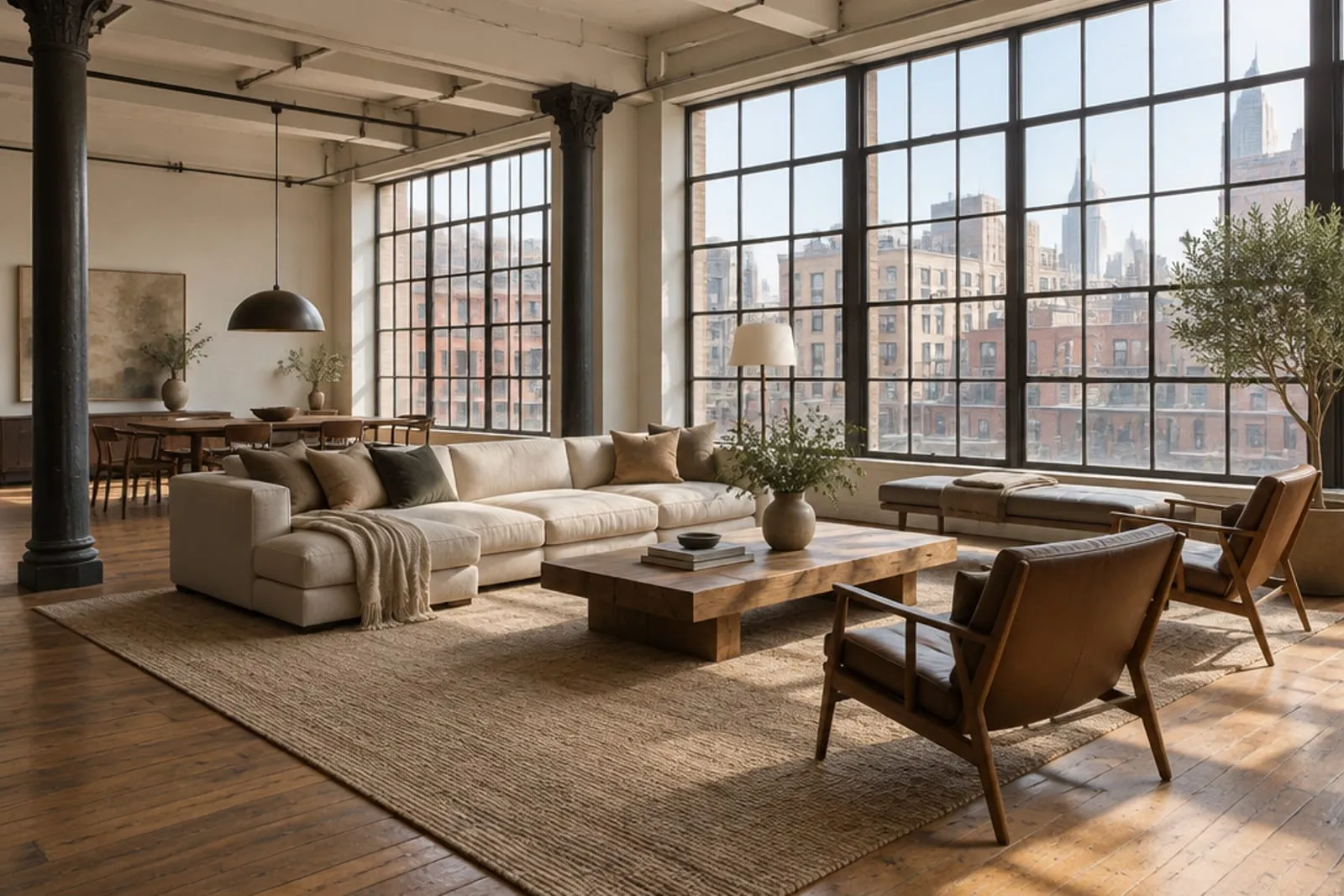
Tribeca is nineteenth and early twentieth century textile, dry goods, and produce warehouses converted to residential lofts, much of it protected within the four Tribeca historic districts designated between 1991 and 2002. The apartments inside are open-plan, with high ceilings, structural columns, and very few interior walls.
In a space like that, rugs do the work walls do elsewhere. They mark the living area, the dining zone, the sleeping end. That has three practical consequences
A typical Tribeca loft holds three or four significant rugs where an uptown apartment holds one or two. Send them together — you pay one minimum charge and one pickup, and most shops discount volume. It is the easiest saving available on this page.
Open-plan zones take 10×14s and larger, and plenty are custom-sized or irregular to fit around columns. Custom shapes need measuring properly — give length and width at the widest points, since shops quote from the bounding rectangle rather than the true area.
Tibetan and Nepali hand-knotted wool, Moroccan Beni Ourain, high-pile and shag constructions, wool-viscose and wool-silk blends. High-pile rugs trap far more soil than flatweaves and take substantially longer to dry — expect the upper end of any turnaround estimate. Blended rugs are the trap: a wool-viscose blend must be treated as viscose, because the weakest fibre sets the method.
These buildings were warehouses, so they have freight elevators sized for cargo and loading arrangements built for moving large goods. Getting an oversized rug out of a Tribeca loft is far easier than out of a prewar building uptown. Confirm your building's freight hours, but the physical constraint that dominates on the Upper West Side mostly does not apply here.
Original timber floors are the risk Tribeca owners underestimate. Many lofts retain their nineteenth-century wide-plank or old-growth timber floors, and that timber is porous, irreplaceable, and unforgiving of moisture. A rug returned even slightly damp, or laid on a non-breathable pad, can cup boards, raise grain, or leave a permanent shadow. Ask how the rug will be dried and what pad is recommended before it goes out — a competent shop raises this unprompted.
Lower Manhattan is flood-exposed, and Tribeca sits on the Hudson edge of it. Ground-floor and lower-level units, basements, and storage areas carry real water risk from storm surge and from the burst-pipe failures common in old buildings. If a rug has been wet, time matters more than anything else: wool begins to smell within a day, dyes migrate, and mould establishes in cellulose backings fast. Do not dry it flat on the floor and hope — that is how a salvageable rug becomes a loss. See water damage restoration.
Tribeca conversions are predominantly condominiums rather than co-ops, so vendor approval is generally lighter than the co-op boards uptown — but most buildings still require a certificate of insurance naming the building and managing agent, and most restrict vendor work to standard daytime hours. The genuine street-level constraint is different: narrow, often cobbled streets, limited loading, and Canal Street traffic mean a van cannot always sit outside for long. Companies that work Tribeca routinely plan around this; it is why a pickup window here may be wider than you expect.
Four historic districts cover much of the neighborhood, and the Landmarks Preservation Commission governs exterior work. Taking a rug out and bringing it back is not something it regulates.
Low-moisture or solvent methods only, never immersion. Confirm the shop has handled viscose before and ask what happened.
Tibetan, Nepali, and Moroccan hand-knotted wool is the neighborhood's most common quality rug. In-plant washing, pH-neutral chemistry.
Deep pile traps far more soil than a flatweave and takes considerably longer to dry properly. Not every shop has the drying capacity; ask.
Tribeca has significant converted commercial space — studios, showrooms, offices, and restaurants — with different scheduling needs and usually after-hours access.
Tribeca sits at the upper end of the Manhattan range.
| Rug type | Per sq ft | 9×12 (108 sq ft) | 12×15 (180 sq ft) |
|---|---|---|---|
| Synthetic | $4 – $6 | $432 – $648 | $720 – $1,080 |
| Wool (hand-knotted) | $5 – $8 | $540 – $864 | $900 – $1,440 |
| Persian / Oriental | $6 – $9 | $648 – $972 | $1,080 – $1,620 |
| Viscose / blends | $6 – $12 | $650 – $1,300 | $1,080 – $2,160 |
| Silk | $7 – $12+ | $756 – $1,296+ | $1,260 – $2,160+ |
Minimum charge is typically $150 to $250, and most companies include free pickup and delivery. Viscose is priced near the top not because it is difficult to clean but because the shop is carrying real risk on a material that fails permanently. Full breakdown on the rug cleaning cost calculator.
The Tribeca-specific saving: send all your rugs in one collection. One minimum, one pickup, volume discount. In a loft with four rugs this is worth several hundred dollars.
Compare the same job, not three different scopes
Describe the rug or rooms, access and treatments once, then compare written, all-in quotes.
Local pricing
The rate card is the same everywhere in Manhattan. What moves your total in Tribeca is the building it comes out of.
Stair, minimum and access figures are the citywide ranges from the RugRate price reference, not quotes from any company.
10013 and 10007, covering Tribeca — the Triangle Below Canal — bounded by Canal Street to the north, Broadway to the east, Chambers Street to the south, and West Street and the Hudson to the west. 10007 covers the southernmost blocks.
Viscose feels cool and slick; silk and wool feel warmer. Crush the pile with your hand — wool springs back, viscose stays flat and takes on a shine where it was pressed. A drop of water on a hidden fibre will darken and stiffen viscose noticeably. And price is the plainest tell: if a large rug that looks like silk cost a few thousand dollars rather than tens of thousands, it is almost certainly viscose. If in doubt, send photos of the front, back, and pile when you request quotes and let the cleaner identify it before anyone quotes a method.
Some will and many will not, and a refusal is a sign of competence rather than laziness. Viscose loses strength when wet, yellows on contact with water, and crushes permanently — the failures are unrepairable and the liability is real. Companies that do accept viscose use low-moisture or solvent methods rather than immersion washing, and price to reflect the risk. Filter this page to companies confirmed for viscose work.
At the upper end of the Manhattan range: roughly $5 to $8 per square foot for hand-knotted wool, $6 to $9 for Persian or Oriental, and $6 to $12 for viscose and blends, with a $150 to $250 minimum. Because loft rugs run large, a 9×12 wool rug typically lands between $540 and $864.
Yes, and it is the single biggest saving available. You pay one minimum charge rather than four, one pickup rather than several, and most shops discount volume. In a loft with several large rugs this is worth several hundred dollars.
Almost always. These buildings were built as warehouses and their freight elevators were sized for cargo, so oversized rugs move far more easily here than in prewar buildings uptown. Confirm your building's freight hours when booking — most restrict vendor access to standard daytime hours — but the physical fit is rarely the problem it is elsewhere in Manhattan.
Yes, and it is worth raising before the rug leaves. Nineteenth-century wide-plank and old-growth timber is porous and irreplaceable, and a rug returned even slightly damp — or laid on a non-breathable pad — can cup boards, raise grain, or leave a permanent shadow. Ask how the rug will be dried and what pad is recommended.
Act immediately; time matters more than anything else. Wool starts to smell within a day, dyes migrate, and mould establishes quickly in cellulose backings. Do not dry it flat on the floor — get it lifted, get air under it, and contact a restoration specialist the same day. Lower Manhattan's flood exposure and the burst-pipe failures common in old buildings make this a genuine Tribeca risk, particularly on ground and lower floors.
Most do. Tribeca conversions are predominantly condominiums rather than co-ops, so vendor approval is generally lighter than the co-op boards uptown, but buildings still typically require a certificate naming the building and managing agent as additional insured and restrict vendor work to daytime hours. Confirm with your managing agent before booking.
No. Four Tribeca historic districts cover much of the neighborhood, but the Landmarks Preservation Commission governs exterior alterations. Removing a rug and returning it is not something it regulates. Your building's own vendor rules are what to check.