
PureGreen Carpet and Rug Cleaning
- Area rug cleaning
- Oriental and Persian rug cleaning
- Rug repair
- Carpet cleaning
Manhattan · Upper East Side
Rug cleaners serving the Upper East Side, from 59th Street to 96th Street and Fifth Avenue to the East River — ZIP codes 10021, 10028, 10065, 10075, and 10128. Rug cleaning on the Upper East Side has two complications you will not find in most of the city: the neighborhood holds an unusual concentration of antique and hand-knotted rugs, and its prewar co-op boards have some of the strictest vendor requirements in Manhattan.
These companies list Manhattan in their service area. Confirm they cover your Upper East Side address when you call.
Ratings are each platform’s own figures, linked to the listing. Details come from each company’s website; RugRate has not yet verified these companies.
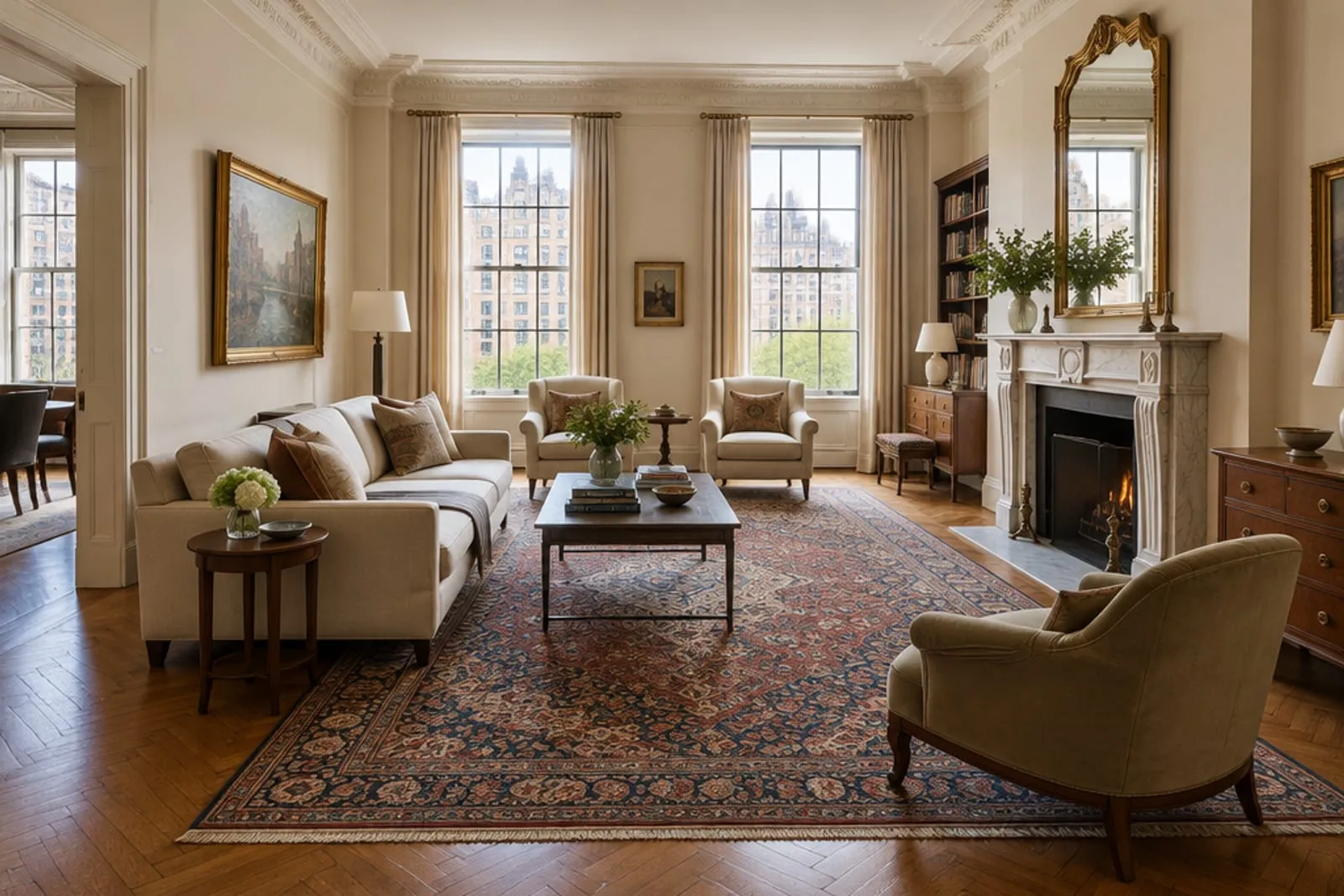
More hand-knotted, antique, and inherited rugs sit in Upper East Side apartments than anywhere else in New York. Between Fifth and Lexington especially, a rug is as likely to have arrived through a family or a Madison Avenue gallery as through a furniture store — which changes what "getting it cleaned" should mean.
Three consequences worth knowing before you book
An antique Tabriz or a nineteenth-century Heriz is a textile with unstable natural dyes and a foundation that may already be fragile. It needs colourfastness testing, cold water, hand washing, and controlled drying — not a truck-mount and an afternoon. The gap between the right shop and the wrong one is measured in thousands of dollars of permanent damage.
If you do not know what a rug is worth, find out before it leaves the apartment. It changes the insurance conversation, it changes which shops you should be talking to, and it is the difference between a claim and an argument if something goes wrong.
The Upper East Side's prewar housing stock — much of it built in the 1910s and 1920s — runs on steam radiators, and sustained dry winter heat makes wool brittle and accelerates fading where a rug sits near a radiator or a south-facing window. If a rug has spent a decade in a heated prewar apartment, expect a cleaner to flag dryness and fibre wear. That is a competent assessment, not an upsell.
The neighborhood is not uniform, and the practical experience of getting a rug collected differs sharply from west to east.
Prewar co-op buildings, mansions, and townhouses, much of it inside the Upper East Side Historic District (designated 1981) or the Metropolitan Museum, Park Avenue, and Carnegie Hill historic districts. Almost all doorman-staffed, almost all requiring a certificate of insurance, and generally the strictest vendor rules in the neighborhood. Also the highest concentration of valuable rugs — a shop that works this corridor regularly will have the paperwork process down to a routine.
A mix of prewar co-ops, postwar high-rises, and townhouses. Hospital-adjacent blocks around Lenox Hill and Weill Cornell have real loading constraints during weekday hours, which affects pickup windows more than people expect.
Prewar co-ops and townhouses, a great deal of it landmarked, and heavily family-occupied. Expect larger rugs, more dining-room and playroom traffic, and more frequent pet and food damage than the corridor to the south.
The most different part of the neighborhood, and the part most often mishandled by a boilerplate UES page. Second and Third Avenues were lined with tenements until the elevated railways came down and high-rise construction took over from the 1950s. The result is a mix of walk-up tenement conversions and postwar towers, with more rentals, fewer co-op boards, fewer certificate-of-insurance demands, and easier access — but more walk-up stairs. Rugs here skew newer and more synthetic. If you are in Yorkville, you probably need a straightforward wash and a company that does not charge Fifth Avenue rates for it.
This is where an Upper East Side rug pickup actually goes wrong, and it is worth ten minutes before you book.
Nearly every doorman co-op and managed condo requires vendors to file a certificate naming the building and the managing agent as additional insured, and UES prewar boards are known for requiring more than the Manhattan baseline — higher coverage limits, specific wording, and the certificate on file several business days ahead. Ask your managing agent for the exact requirements, then confirm the cleaning company can meet them before you schedule. A missing or incorrectly worded certificate is the most common reason a pickup is turned away at the service door.
Most prewar buildings route vendors through a service entrance, and freight elevators frequently run weekdays only with limited hours. Some buildings restrict vendor access entirely during certain periods. Confirm your building's freight schedule and give it to the company when you book — this constrains the pickup window more than anything on the cleaner's end.
No freight elevator, no service entrance, and often a narrow staircase and a stoop. Easier on paperwork, harder on logistics, especially for anything over 9×12. Mention the stairs when you request a quote.
East of Third you are more likely in a converted tenement with a narrow staircase and no elevator. Carrying a rolled 9×12 wool rug down five flights is real labor — give the floor when you ask for a quote so it is priced upfront rather than renegotiated on your landing.
Much of the Upper East Side is landmarked, and it worries people unnecessarily. Landmark rules govern exterior work. Removing and returning a rug is not something the Landmarks Preservation Commission has any interest in.
The service this neighborhood needs most. Closer to textile conservation than cleaning. Never accept a flat per-square-foot price on an antique sight unseen — a competent shop insists on inspecting first.
Hand-knotted rugs with natural dyes. Colourfastness testing before washing is non-negotiable; dye bleed is permanent.
Fewer shops do this properly than advertise it. Ask how many silk rugs they handle in a month.
Reweaving, fringe replacement, moth damage, and worn foundations. Common on rugs that have been in the same family for decades.
Urine must be flushed from the foundation, which means full immersion at a plant. On-site treatment masks it temporarily.
Upper East Side prewar apartments frequently have original herringbone or parquet floors, and a rug returned even slightly damp — or laid on a non-breathable pad — can cup or stain them. Ask how the rug will be dried and what pad is recommended. A good shop raises this before you do.
Upper East Side quotes sit at the top of the Manhattan range, which is itself the top of the city range.
| Rug type | Per sq ft | 8×10 rug |
|---|---|---|
| Wool | $5 – $8 | $400 – $640 |
| Persian / Oriental | $6 – $9 | $480 – $720 |
| Silk | $7 – $12+ | $560 – $960+ |
| Antique / heirloom | Quoted after inspection | Inspection first |
Minimum charge is typically $150 to $250, and most companies include free pickup and delivery. Full breakdown on the rug cleaning cost calculator.
Be sceptical of both ends here. A very low quote on a hand-knotted rug means a surface clean, not a wash. A very high one sometimes means a Madison Avenue storefront rather than better work — and since almost no rug washing actually happens in Manhattan, you may be paying rent rather than craft. Ask where the plant is.
Compare the same job, not three different scopes
Describe the rug or rooms, access and treatments once, then compare written, all-in quotes.
Local pricing
The rate card is the same everywhere in Manhattan. What moves your total in Upper East Side is the building it comes out of.
Stair, minimum and access figures are the citywide ranges from the RugRate price reference, not quotes from any company.
10021, 10028, 10065, 10075, and 10128, covering the Upper East Side from 59th Street to 96th Street between Fifth Avenue and the East River.
Almost certainly yes. Nearly every doorman co-op and managed condo on the Upper East Side requires vendors to file a certificate naming the building and managing agent as additional insured, and prewar boards here often require higher limits and specific wording than the Manhattan baseline, filed several business days in advance. Get the exact requirements from your managing agent, then confirm the company can meet them before booking.
Expect the top of the Manhattan range: roughly $5 to $8 per square foot for wool, $6 to $9 for Persian or Oriental, and $7 to $12 or more for silk, with a $150 to $250 minimum. An 8×10 wool rug typically runs $400 to $640. Antique rugs are quoted after inspection rather than by the square foot.
Companies with in-plant washing facilities and technicians trained in fibre identification and dye testing — look for an IICRC Rug Cleaning Technician certification or WoolSafe Approved status. Filter this page to antique and Persian specialists. Avoid general carpet cleaning companies entirely for hand-knotted rugs; it is a different trade.
Essentially none. The floor space, drainage, and drying rooms required are not viable at Upper East Side rents. Madison Avenue and Lexington Avenue storefronts are intake points; the washing happens in Long Island City, Sunset Park, or elsewhere in Queens and Brooklyn. This is normal — but it means an Upper East Side address tells you nothing about where your rug will actually be washed. Ask where the plant is.
It changes the labour, not the cleaning. Give the floor number when you request a quote so the stairs are priced upfront rather than renegotiated on the day. On the upside, walk-up and rental buildings east of Third Avenue rarely have the certificate-of-insurance requirements that slow pickups west of Lexington.
No. Landmark designation governs exterior alterations. Removing a rug and returning it involves nothing the Landmarks Preservation Commission regulates. Your co-op board's own vendor rules are the thing to check.
Five to fourteen days for in-plant washing, including pickup, drying, and delivery. Antique and silk rugs often sit at the longer end because drying is slower and more controlled. Drying cannot safely be rushed, and a rug returned damp will damage a prewar parquet floor.
Judge on method, fibre specialism, and insurance rather than address. Since almost no washing happens in the neighborhood anyway, a Queens company with a proper plant and antique experience is often a better choice than a local storefront that sends work to the same plant at a markup. What a local company genuinely offers is familiarity with your building type and its paperwork.