
PureGreen Carpet and Rug Cleaning
- Area rug cleaning
- Oriental and Persian rug cleaning
- Rug repair
- Carpet cleaning
Brooklyn · Brooklyn Heights
Rug cleaners serving Brooklyn Heights — from Old Fulton Street south to Atlantic Avenue, between Cadman Plaza West and the river, in ZIP code 11201. This is the oldest residential neighborhood in the city and it became New York's very first historic district in 1965, with over six hundred pre-Civil War houses. The rugs here tend to be old too, and often to have sat in the same room for decades without ever being professionally washed. That is a specific job with specific risks, and it is what most of this page is about. Rug that has not been cleaned in decades? Start with what a first wash involves. Comparing shops? See them side by side.

These companies list Brooklyn in their service area. Confirm they cover your Brooklyn Heights address when you call.
Ratings are each platform’s own figures, linked to the listing. Details come from each company’s website; RugRate has not yet verified these companies.
A rug that has been in the same room since the 1980s is not a routine job, and it is worth knowing what you are asking for before you ask.
First: it almost certainly needs it, and the delay has already cost something. A rug that has gone twenty or thirty years without a proper wash holds several pounds of dry grit in its foundation. That grit has been cutting the fibres at the base of the pile every time anyone walked across it, and that damage is permanent and unrepairable. Washing stops the process. It does not undo it.
Second: expect the wash to reveal things. This is the part nobody warns people about, and it causes most of the upset.
Larvae feed in undisturbed dark places, which means beneath the sofa, along the wall, under the bed. A rug can look intact and have bare patches you have never seen. Lifting it is often the moment you find out.
Previous binding, patches, or reweaving done cheaply or badly may become visible once the rug is clean and the surrounding soil is gone.
Decades of soil dulls everything uniformly. A clean rug can look surprisingly different — occasionally more worn, because wear that was hidden under grey is now visible against bright colour.
The section that sat by a window or a radiator will have faded, and the difference shows more once the rest is clean.
None of that is the cleaner's doing, and a good shop tells you what it expects to find before it starts. One that promises the rug will look new is telling you what you want to hear.
Third: it may need testing before anyone commits. An old rug with unstable dyes, a weakened foundation, or dry rot cannot simply go into a wash. A competent shop inspects first, tests colourfastness, checks the foundation's strength, and gives you a written assessment. If a shop offers a flat per-square-foot price on a forty-year-old rug over the phone, that is the wrong shop.
Fourth: it will cost more than a routine clean, legitimately. Heavy soil means more dusting time and more passes. That surcharge should appear in a written estimate before pickup, not after.
And occasionally the honest answer is no. A rug with a rotted foundation or advanced structural damage may not survive washing, and a good cleaner will say so rather than take the money. That is a sign of competence, not a lost sale.
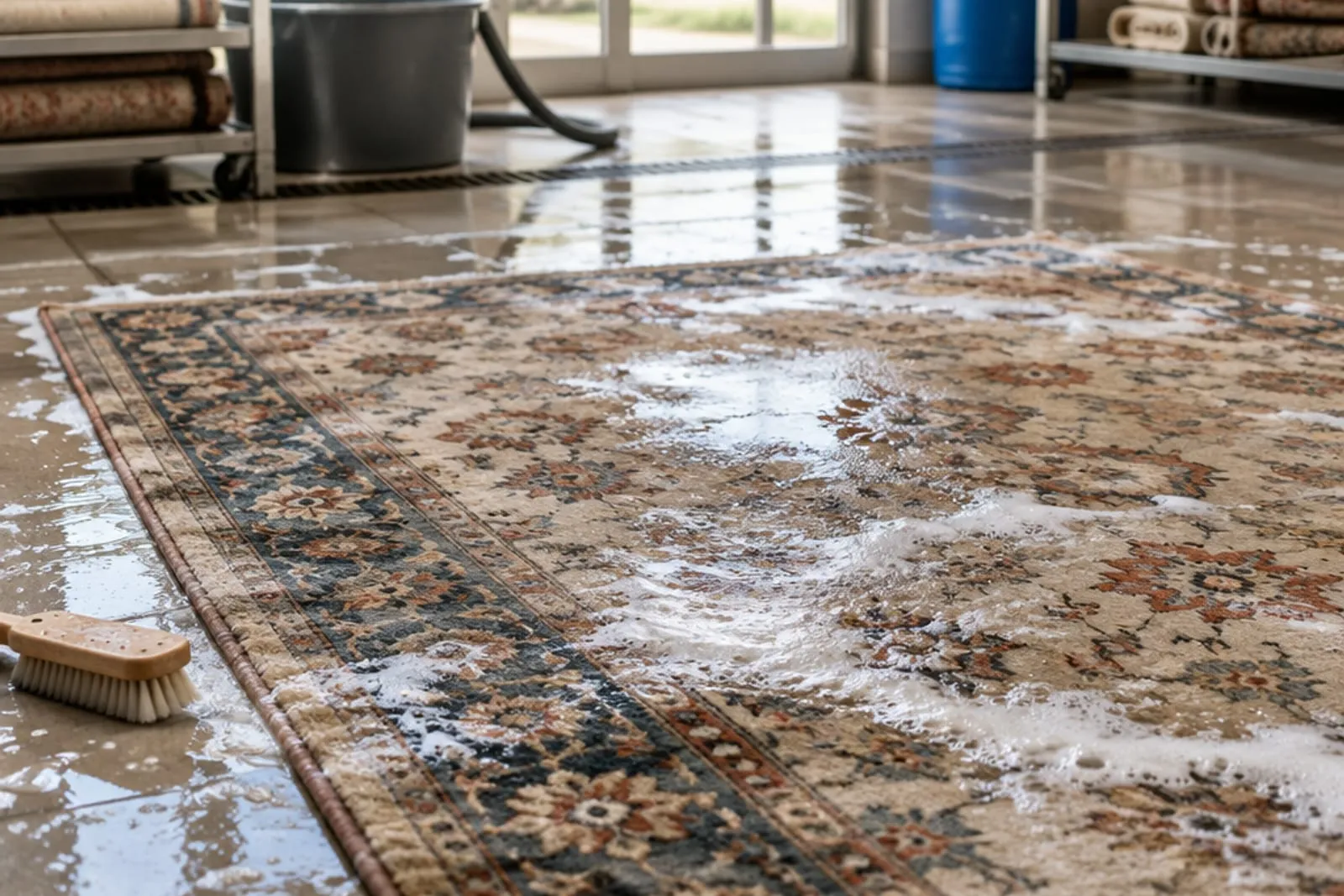
Get an old rug looked at before you decide anything. Households in Brooklyn Heights have held onto rugs for generations, and people are frequently wrong in both directions — some assume an inherited rug is valuable when it is a decent machine-made piece, others put a genuinely significant hand-knotted rug in a hallway because nobody ever told them.
How to tell hand-knotted from machine-made yourself: look at the back. A hand-knotted rug shows the pattern clearly through to the reverse with visible individual knots and slight irregularity; a machine-made rug has a stiff uniform backing, often with a glued mesh, and a much less distinct pattern from behind.
If it is hand-knotted and old, an appraisal before cleaning is worth the modest cost. It changes the insurance conversation, it changes which shops you should be talking to, and it is the difference between a claim and an argument if something goes wrong in someone's custody.
The economics, honestly. The general rule is to replace rather than clean when cleaning exceeds about 40% of replacement value. For a genuinely old hand-knotted rug that rule almost never applies — these last generations when maintained, and replacement is not really available. For a mid-century machine-made rug with sentimental value only, cleaning is a choice rather than an investment, and that is a perfectly reasonable thing to spend money on as long as you know which one you are doing.
Brooklyn Heights was designated New York City's first historic district on 23 November 1965, covering roughly 236 acres. The stock runs from early Federal houses through Greek Revival, Italianate, Second Empire and Victorian Gothic, and rare early nineteenth-century wooden frame houses survive in the northern part of the neighborhood.
Houses of this age frequently retain original softwood floors — wide-plank pine and similar — which are considerably softer, more porous and more moisture-sensitive than the parquet in a 1920s apartment. A rug returned even slightly damp, or laid on a non-breathable rubber-backed pad, can cup boards, raise the grain, or leave a shadow that does not come out.
Ask how the rug will be dried and confirm it comes back fully dry, and use a breathable pad — natural rubber and felt rather than a solid synthetic backing. A good shop raises both before you do.
Three- to five-storey rowhouses with a stoop, an internal staircase, and no elevator. You need to be home for pickup and delivery. Early Federal and Greek Revival houses have narrower rooms than the late-Victorian houses further into Brooklyn, so rugs here tend to run smaller than in Park Slope — worth mentioning when you request a quote, along with your floor and any tight staircase turns.
Grace Court Alley and Hunts Lane are converted stables and carriage houses with unusual layouts and constrained access off narrow lanes. Mention it when booking; a crew that knows what it is coming to will plan the pickup properly.
Rarely needed in owner-occupied houses. Check with management if you are in one of the converted apartment buildings or a co-op, where requirements do apply.
The neighborhood's defining service. Inspection and written assessment before any price is quoted.
Reweaving, moth-damage repair, fringe and binding. Often discovered as necessary once a neglected rug is cleaned, so budget for the possibility.
Typically $20 to $50 per rug, or $0.50 to $3.00 per square foot. Worth doing on any old wool rug that has been undisturbed for years.
Typically $20 to $60 a month. If you are renovating an old house, get the rugs out and cleaned before the work starts rather than after — construction dust in an already-neglected rug compounds the problem considerably.
Brooklyn rates, which are the best value in the city for in-plant washing.
| Rug type | Per sq ft | 6×9 (54 sq ft) | 8×10 (80 sq ft) |
|---|---|---|---|
| Wool | $4 – $7 | $216 – $378 | $320 – $560 |
| Persian / Oriental | $5 – $8 | $270 – $432 | $400 – $640 |
| Silk | $6 – $10 | $324 – $540 | $480 – $800 |
| Antique or fragile | Quoted after inspection | — | — |
Minimum service charge is $150 to $250, and most companies include free pickup and delivery. Heavy-soil surcharges on long-neglected rugs are legitimate and should appear in the written estimate before pickup. Full breakdown on the rug cleaning cost calculator.
Compare the same job, not three different scopes
Describe the rug or rooms, access and treatments once, then compare written, all-in quotes.
Local pricing
The rate card is the same everywhere in Brooklyn. What moves your total in Brooklyn Heights is the building it comes out of.
Stair, minimum and access figures are the citywide ranges from the RugRate price reference, not quotes from any company.
11201, covering Brooklyn Heights from Old Fulton Street south to Atlantic Avenue, between Cadman Plaza West and the river.
Usually not, but have it inspected before anyone quotes a price. A rug that has gone decades without washing holds pounds of grit in its foundation, and that grit has been cutting the fibres the whole time — washing stops the damage but cannot reverse it. A competent shop will inspect, test colourfastness, check the foundation's strength, and give you a written assessment first. Occasionally the honest answer is that a rug with a rotted foundation will not survive washing, and a good cleaner will tell you that rather than take the money.
Often moth damage under furniture, where larvae feed undisturbed — bare patches beneath the sofa or along a wall that you have never seen. Also old cheap repairs that become visible once surrounding soil is gone, uneven fading where the rug sat by a window or radiator, and colours markedly different from what you are used to. None of it is caused by the cleaning, and a good shop warns you in advance.
No, and be sceptical of anyone who says it will. Cleaning removes soil and lifts crushing, but fibre worn away over decades is gone and cannot be restored by washing. What you should expect is a rug that is genuinely clean, brighter, and no longer being damaged — which is a considerable improvement, just not the same thing as new.
If it is hand-knotted and old, yes — the cost is modest and it changes both the insurance conversation and which shops you should be dealing with. To check whether it is hand-knotted, look at the back: a hand-knotted rug shows the pattern clearly through to the reverse with visible individual knots, while a machine-made rug has a stiff uniform backing and a much less distinct pattern.
Drying. Houses of this age often retain original softwood floors, which are softer, more porous and far more moisture-sensitive than modern parquet. A rug returned even slightly damp, or laid on a solid rubber-backed pad, can cup boards or leave a permanent shadow. Ask how the rug will be dried, confirm it comes back fully dry, and use a breathable natural rubber and felt pad rather than a synthetic backing.
Almost always moths, feeding in undisturbed places — under furniture, along walls, in closets. Look for fine webbing and small sandy casings nearby. Treat it promptly since larvae keep feeding, ask for moth treatment alongside cleaning, and note that damaged areas can usually be rewoven.
Because heavy soil genuinely takes more work — more dusting time and more washing passes — and because a fragile old rug needs testing and careful handling that a routine job does not. That surcharge is legitimate, but it should appear in a written estimate before pickup rather than being added afterwards.
Mention it when booking. The mews carriage houses have unusual layouts and access off narrow lanes, which affects where a van can stop and how the crew plans the carry. A company that knows in advance handles it easily; one that turns up blind may not.
Brooklyn rates, the best value in the city: roughly $4 to $7 per square foot for wool and $5 to $8 for Persian or Oriental, with a $150 to $250 minimum. An 8×10 wool rug typically runs $320 to $560. Antique and fragile rugs are quoted after inspection rather than by the square foot.