
PureGreen Carpet and Rug Cleaning
- Area rug cleaning
- Oriental and Persian rug cleaning
- Rug repair
- Carpet cleaning
Brooklyn · DUMBO
Rug cleaners serving DUMBO — Down Under the Manhattan Bridge Overpass, between the two bridges and east toward Vinegar Hill, in ZIP code 11201. DUMBO's converted factory buildings have hard floors and carry sound between units, which is why so many buildings here require residents to keep most of their floors covered. That turns rugs from decoration into something closer to building equipment — and it raises a question nobody usually answers: what happens when the rug goes out for cleaning? Building requires floor coverage? See how to stay compliant while your rug is away. Comparing shops? See them side by side.
These companies list Brooklyn in their service area. Confirm they cover your DUMBO address when you call.
Ratings are each platform’s own figures, linked to the listing. Details come from each company’s website; RugRate has not yet verified these companies.
First, an important correction to something widely misunderstood: this is not a law. There is no New York City ordinance requiring you to carpet your apartment. What exists is a building bylaw — a common house rule in co-ops, condos and many rental buildings requiring roughly 80% of floor area to be covered with rugs or carpet to limit sound transmission to the unit below.
Where it applies, it is enforceable by your board or managing agent, and in a co-op it typically sits in the proprietary lease or house rules. Ignoring it can mean warnings, fines, and in a serious ongoing dispute, real pressure from the board.
What varies, considerably
Whether it covers the whole apartment or only living areas and bedrooms. Buildings interpret this differently, and the ambiguity causes most of the arguments.
Some buildings count only the rug; others accept the rug plus a pad; some specify a minimum pad thickness.
Kitchens and bathrooms are usually excluded. Whether a health reason — asthma, dust allergy — gets you an exemption depends entirely on your board, and often the answer is no.
The number is a convention, not a standard, and some buildings specify a different figure or no figure at all, just "adequate covering."
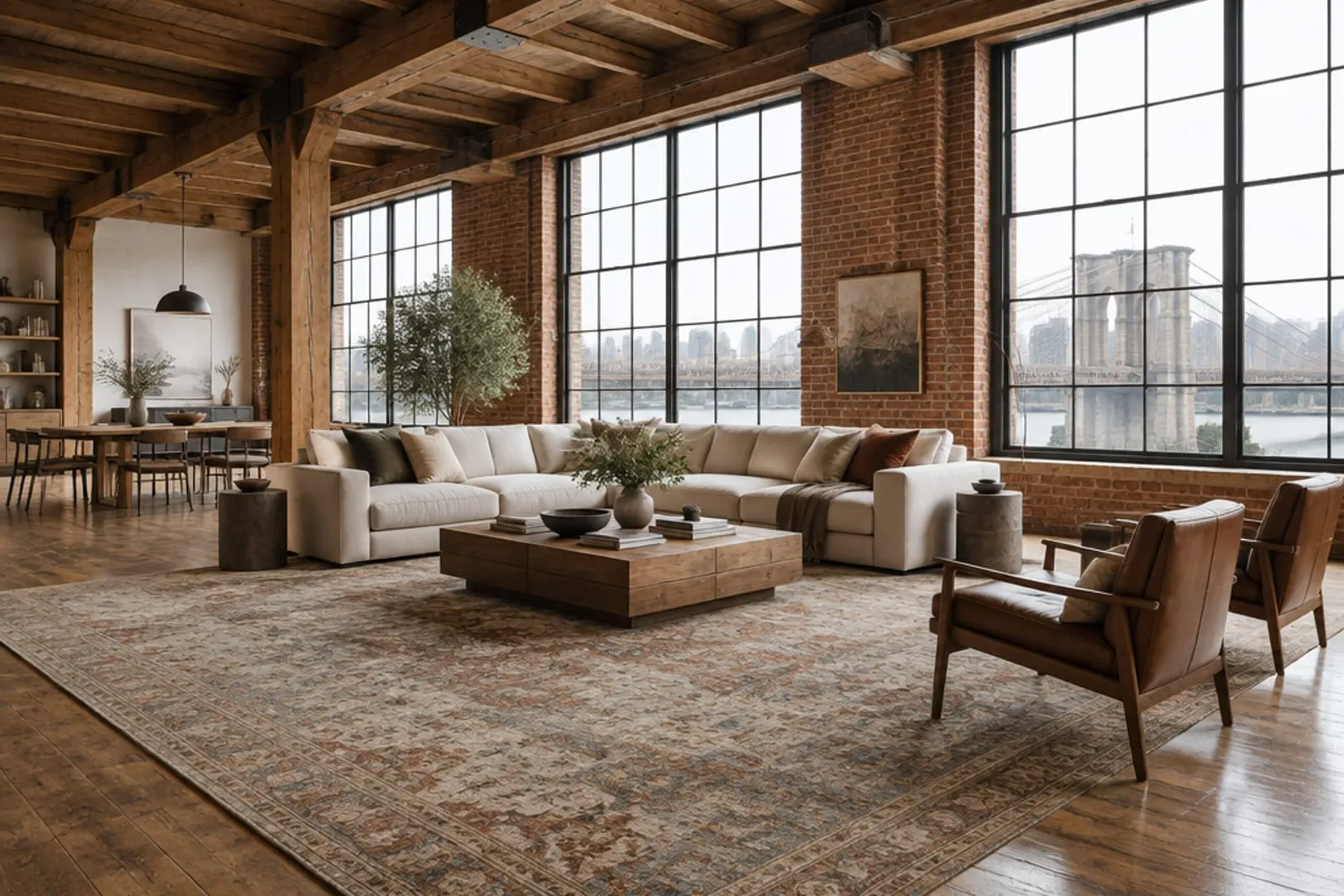
These are converted factories, many among the earliest large-scale reinforced concrete industrial buildings in the country. Concrete floors and high ceilings move sound efficiently, and a bare loft floor above a neighbour is genuinely loud. The rule exists here for a real reason rather than as a formality.
This is the practical problem the rule creates, and it catches people out every time.
Proper in-plant washing takes five to fourteen days. If your building requires floor coverage and your only large rug is at a plant in Gowanus, you are technically non-compliant for a fortnight — and if you have a neighbour who has complained before, that is exactly when they will notice.
Four ways to handle it, in order of how well they work
If you have more than one rug, send them in batches rather than all at once so the apartment is never bare. This is the opposite of the money-saving advice on most of this site — where sending everything together saves a minimum charge — so it is a genuine trade-off. In a compliance building, staggering usually wins.
Some companies keep basic rugs to leave in place while yours is away. It is not universal and it is rarely advertised, so ask specifically — it is the cleanest solution when available.
A short email saying a rug is out for professional cleaning and will return by a given date is usually all it takes. Boards are reasonable about maintenance; they are much less reasonable about being surprised.
If your downstairs unit is empty between tenancies, or the neighbour is away, that is the window.
A rug that never leaves the floor because of a house rule is a rug being slowly destroyed by the grit in it. The rule is a scheduling problem, not a reason to neglect the rug.
Most people buy the wrong pad, because the two common types do completely different jobs.
Anti-slip pads are thin, open-weave, often rubber and PVC. They stop a rug sliding on a hard floor. They do very little for sound.
Acoustic or cushioning pads are thicker — typically felt, or felt bonded to natural rubber — and they absorb impact. These are what actually reduce the footfall noise your neighbour hears, and what most floor-covering rules are really aiming at.
For a DUMBO loft over concrete, you want felt-and-rubber, and you want thickness. A thin anti-slip mat under a rug in a building with a floor-covering rule technically satisfies nobody: the board may still count it, but your downstairs neighbour will still hear you.
Two things to avoid. Solid rubber-backed or PVC-backed pads trap moisture against the floor and can mark or discolour timber — a real risk in converted buildings with original floors. And cheap adhesive-backed pads can leave residue that is very difficult to remove from a rug's foundation.
A good pad also extends the rug's life by absorbing impact that would otherwise crush the pile, and by letting air circulate underneath so anything spilled can dry rather than sitting against the floor. It is the cheapest thing you can do for a rug you intend to keep.
The DUMBO Historic District was designated in December 2007 — New York City's 90th — covering 95 contributing buildings originally built for manufacturing. Nineteenth and early twentieth-century industrial structures, converted from the late twentieth century onward, largely by Two Trees Management.
These were factories, so they have loading areas and large freight elevators, and the residential conversions are professionally managed with doormen or concierge, package rooms and established vendor procedures. Certificates of insurance are usually required but the process is standard and familiar to any company working the neighborhood. Confirm the freight schedule when you book and the rest follows.
Open-plan spaces take large rugs, often 10×14 and up, and the sizing and fibre considerations are covered in depth on the Tribeca page — including how to tell viscose from silk, which matters just as much here.
DUMBO sits directly on the water between two bridges, and ambient humidity runs higher than inland, particularly on lower floors. A rug on a cool floor against an exterior wall can develop musty odour underneath. Mention it when you book if you notice it, since it needs different handling from ordinary soiling.
Public housing in the neighborhood's eastern part has its own vendor access rules set by NYCHA rather than a private managing agent. Check with your management office before scheduling.
Companies working DUMBO plan around it.
The loft staple, and the fibre that performs best acoustically.
Confirm the company can handle rugs over 12 feet; plant drying space is the real constraint.
Immersion at a plant, not surface treatment.
Wall-to-wall in newer conversions and offices, on-site.
DUMBO holds a large share of Brooklyn's tech and creative offices. General workplace guidance, including what desk chairs do to rugs and carpet, is on the Flatiron & Gramercy page.
Brooklyn rates, the best value in the city for in-plant washing.
| Rug type | Per sq ft | 9×12 (108 sq ft) | 12×15 (180 sq ft) |
|---|---|---|---|
| Synthetic | $3 – $6 | $324 – $648 | $540 – $1,080 |
| Wool | $4 – $7 | $432 – $756 | $720 – $1,260 |
| Persian / Oriental | $5 – $8 | $540 – $864 | $900 – $1,440 |
| Silk | $6 – $10 | $648 – $1,080 | $1,080 – $1,800 |
Minimum service charge is $150 to $250, and most companies include free pickup and delivery. Some apply an oversize surcharge above roughly 12 feet — ask before comparing quotes. Full breakdown on the rug cleaning cost calculator.
Note the tension on bundling. Sending several rugs together saves a minimum charge, but in a floor-covering building it leaves you bare for two weeks. Weigh the saving against the house rules rather than defaulting to either.
Compare the same job, not three different scopes
Describe the rug or rooms, access and treatments once, then compare written, all-in quotes.
Local pricing
The rate card is the same everywhere in Brooklyn. What moves your total in DUMBO is the building it comes out of.
Stair, minimum and access figures are the citywide ranges from the RugRate price reference, not quotes from any company.
11201, covering DUMBO between the Manhattan and Brooklyn Bridges and east toward Vinegar Hill. The same ZIP covers Brooklyn Heights, Vinegar Hill, Boerum Hill and part of Downtown Brooklyn, so listed companies generally serve all of them.
No. There is no city ordinance requiring you to carpet your apartment. It is a building rule — a common bylaw in co-ops, condos and many rentals requiring roughly 80% of floor area to be covered for sound insulation — and it is enforced by your board or managing agent, not the city. Where it applies it is genuinely enforceable, typically through the proprietary lease or house rules, so read your building's actual wording rather than relying on the "80%" shorthand. Some buildings specify a different figure, or none at all.
You are technically non-compliant for the five to fourteen days of in-plant washing, which is the practical problem nobody warns you about. Four options: stagger the cleaning if you have more than one rug so the apartment is never bare, ask whether the company keeps loaner rugs, email your managing agent in advance to say a rug is out for professional cleaning and when it returns, or time it for when the unit below is empty. Boards are generally reasonable about maintenance and much less reasonable about surprises.
It depends on your building. Some count the rug only, others accept rug plus pad, and a few specify a minimum pad thickness. This is one of the most common points of disagreement, so check your house rules and ask the managing agent directly rather than assuming.
A thick felt pad, or felt bonded to natural rubber. Thin anti-slip pads — the open-weave rubber or PVC kind — stop a rug sliding but do very little for sound, which is what most people buy by mistake. For a loft over a concrete floor you want felt-and-rubber and you want thickness. Avoid solid rubber- or PVC-backed pads, which trap moisture against the floor and can mark timber.
Yes, meaningfully, provided you use the right pad. Most complaints are about footfall impact rather than airborne sound, and a rug with a thick felt-and-rubber pad absorbs impact at the source, which is far more effective than anything the neighbour can do at their end. Larger coverage and higher pile both help.
No — it is among the easiest in the city. These are converted factory buildings with loading areas and large freight elevators, professionally managed with doormen or concierge and established vendor procedures. Certificates of insurance are usually required but the process is standard. Confirm the freight schedule when you book.
Ask directly. An oversized rug needs a vehicle that fits it, staff to carry it, and enough plant floor space to dry it flat — drying space being the real constraint. Some companies decline rugs over 12 feet or hold them until space frees up, and some apply an oversize surcharge above that length.
Possibly in part. DUMBO sits directly on the water between two bridges and ambient humidity runs higher than inland, especially on lower floors, and a rug on a cool floor against an exterior wall can develop mildew underneath. It is treatable, but say so when you book, since musty odour needs different handling from ordinary soiling.
Brooklyn rates, the best value in the city: roughly $4 to $7 per square foot for wool and $5 to $8 for Persian or Oriental, with a $150 to $250 minimum. A 9×12 wool rug typically runs $432 to $756. Because loft rugs run large, expect the total to be higher than the rate alone suggests.