
PureGreen Carpet and Rug Cleaning
- Area rug cleaning
- Oriental and Persian rug cleaning
- Rug repair
- Carpet cleaning
Brooklyn · Cobble Hill
Rug cleaners serving Cobble Hill — from Atlantic Avenue south to Degraw Street, between Court Street and the BQE, in ZIP codes 11201 and 11231. Cobble Hill has the narrowest houses in brownstone Brooklyn — Warren Place's workingmen's cottages are eleven feet wide — and narrow houses mean narrow halls and a staircase in every one. The floor covering that matters most here is the runner, and runners work differently from area rugs in almost every respect. Runner looking worn on the stair edges? There is a fix, and it is cheaper than replacing — see the shifting trick.
These companies list Brooklyn in their service area. Confirm they cover your Cobble Hill address when you call.
Ratings are each platform’s own figures, linked to the listing. Details come from each company’s website; RugRate has not yet verified these companies.
A runner is not simply a long rug, and treating it like one is how people end up replacing something that could have been maintained.
Stair runners are tacked, stapled, or held with rods, which means cleaning properly involves removal and refitting — often by an installer rather than the cleaning company. That is a real cost and it needs to be in the quote before the work starts, not discovered afterwards.
On a staircase, almost all the damage happens on the front edge of each tread, where the foot lands and where the runner bends over the step. The pile crushes and abrades in narrow bands while the rest of the runner — the risers, the middle of each tread — stays close to new. This is the defining fact about stair runners, and it drives everything else in this section.
In a narrow entry hall, damage concentrates in a single traffic lane along the middle, and at the door where grit arrives.
Cleaning options
Cheaper and faster, and reasonable for a synthetic runner or a light maintenance clean. It is a surface clean — the runner cannot be properly rinsed or dried while fitted to a staircase.
The proper option for wool, and the only one that removes embedded grit from the foundation. Budget for removal and refitting on top of the wash.
Measuring a stair runner: total length is roughly the tread depth plus the riser height, multiplied by the number of steps, plus extra for the nosing curve on each step and for any landing. Add a margin — a runner cut short is scrap. If in doubt, have the installer measure; the cost of an error is the whole runner.
This is the single most valuable thing on this page, and almost nobody knows it.
Because stair runner wear concentrates in narrow bands at each nosing, the worn points sit at fixed, evenly spaced intervals along the runner — one per step. Shift the whole runner up or down the staircase by a few inches, and every worn band moves off the nosing onto the flat of the tread, while fresh pile takes its place at the edge.
Done every few years, this can double or triple the life of a runner.
How it works in practice
If the nosing wear has already gone through to the backing, shifting will not fix it, but the runner can often still be rebound and reused on a shorter run — a back staircase, a landing, a hallway.
Repair is worth more than replacement here, because a fitted runner in a narrow nineteenth-century staircase is not a standard product you can buy off a shelf.
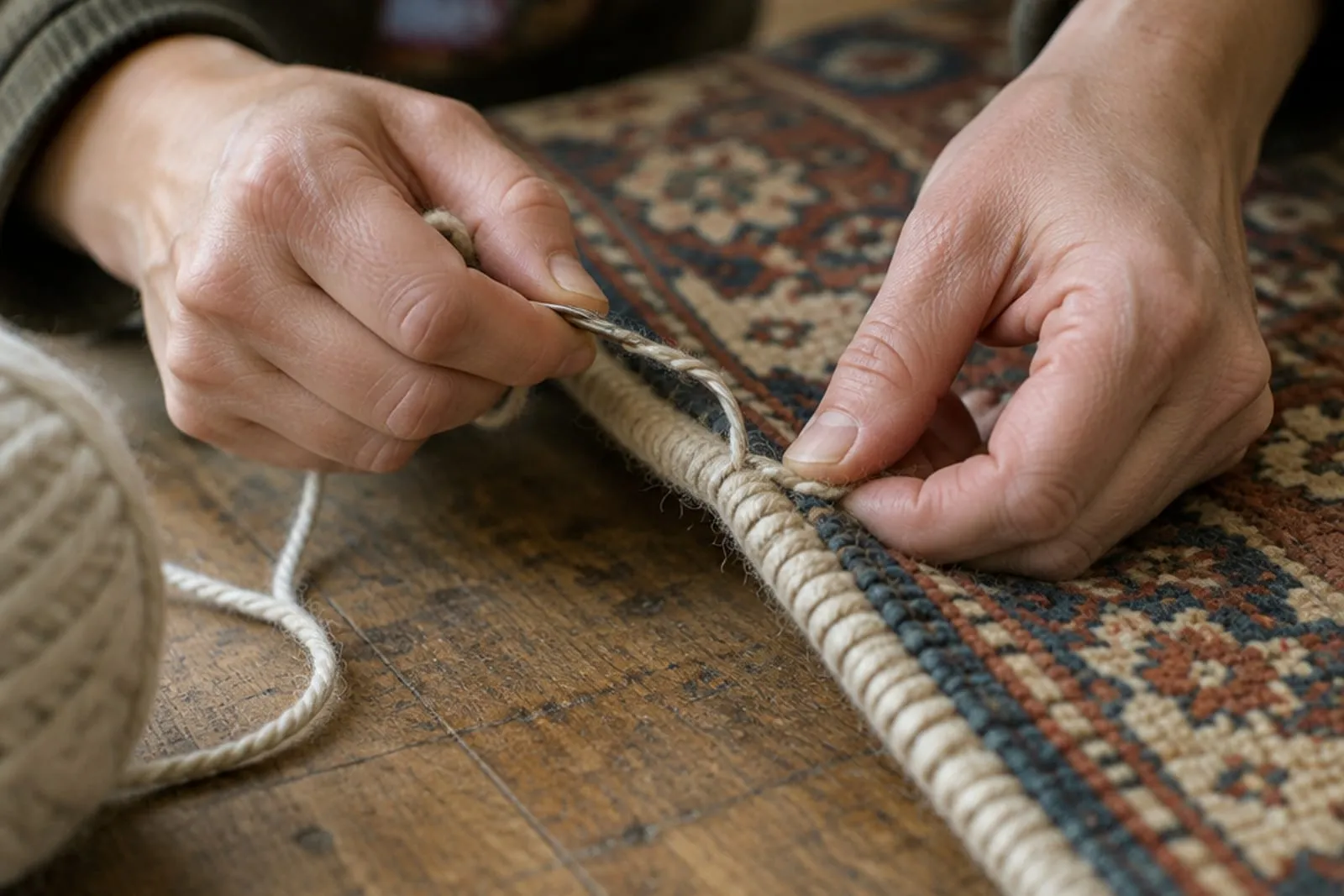
Rebinding the long edges — runners fray along their sides where feet and furniture catch them. Binding and serging typically runs about $3 to $10 per linear foot, and on a runner that is the majority of its length, so get a quote rather than assuming.
Reweaving worn nosing bands — skilled hand work, quoted after inspection, and generally worth it only on a good wool runner.
Re-fringing or re-ending — where the ends have unravelled.
Moth damage — narrow halls and staircases in old houses have exactly the undisturbed edges moths favour. Check along the sides and under any furniture on a landing.
See rug repair or request a repair quote, and send photographs — repair estimates without images are guesses.
The Cobble Hill Historic District was designated in December 1969 and extended in 1988, covering roughly twenty-two blocks of Greek Revival and Italianate rowhouses with Romanesque, Gothic Revival, Queen Anne, Second Empire and neo-Grec among them — one of the city's finest collections of nineteenth-century houses.
Warren Place's 1876 workingmen's cottages, built by William Field & Son around a private courtyard, are eleven feet wide. The Home and Tower Buildings on Hicks Street were built as experimental affordable working-class housing on Alfred Tredway White's "philanthropy plus 5%" principle. Even the standard rowhouses here are narrow by Brooklyn standards.
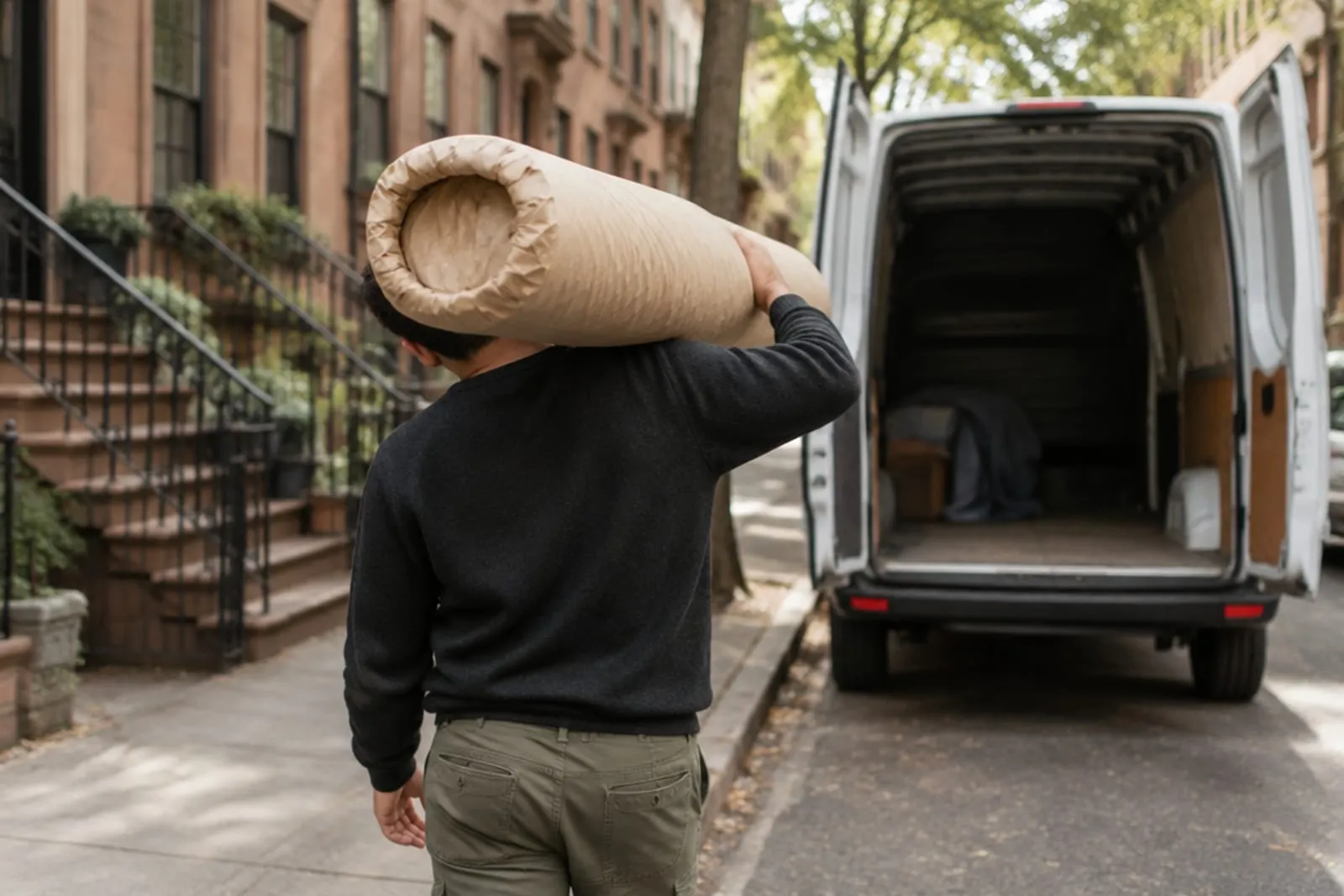
Stoop, narrow internal staircase, no elevator, no doorman. You need to be home. Give your floor and describe the staircase when you request a quote — and note that in the narrowest houses, a large area rug may not come down the stairs at all rolled. Experienced crews carry them folded instead, but they need to know in advance. The full access guidance is on the West Village page, which covers the same problem in Manhattan's narrowest houses.
Check with management only if you are in one of the converted apartment buildings or a newer building near Atlantic Avenue.
Atlantic Avenue holds one of the city's largest concentrations of Middle Eastern shops, many long-established.
Say which language you would like to be served in when you ask companies for quotes — it is a reasonable request, and a shop that can explain the process in your language is one you can properly question.
Confirm whether the company removes and refits, or works with an installer. It changes the quote.
Rebinding, reweaving, re-ending. The highest-value service in this neighborhood.
In-plant, pH-neutral.
Roughly $20 to $50 per rug. Worth doing on any wool runner in an old house.
Brooklyn rates, the best value in the city for in-plant washing.
| Item | Typical cost |
|---|---|
| Wool rug, in-plant | $4 – $7 per sq ft |
| Persian / Oriental, in-plant | $5 – $8 per sq ft |
| 6×9 wool rug | $216 – $378 |
| Minimum service charge | $150 – $250 |
| Runner (2.5 × 10 ft, 25 sq ft) | Minimum charge applies |
| Stair runner removal and refitting | Quoted separately, often by an installer |
| Rebinding | $3 – $10 per linear foot |
| Moth treatment | $20 – $50 per rug |
Note on runners and the minimum. A typical hall runner is around 25 square feet, well under the point where the per-square-foot rate exceeds the $150 to $250 minimum — so a runner is priced by the minimum, not by its size. Send it with your other rugs and you pay one minimum for the lot. The arithmetic is on the Greenwich Village page.
Full pricing on the rug cleaning cost calculator.
Compare the same job, not three different scopes
Describe the rug or rooms, access and treatments once, then compare written, all-in quotes.
Local pricing
The rate card is the same everywhere in Brooklyn. What moves your total in Cobble Hill is the building it comes out of.
Stair, minimum and access figures are the citywide ranges from the RugRate price reference, not quotes from any company.
11201 and 11231, covering Cobble Hill from Atlantic Avenue south to Degraw Street between Court Street and the BQE. Those ZIPs are shared with Brooklyn Heights, DUMBO, Carroll Gardens and Red Hook, so listed companies generally serve all of them.
Yes, but understand what you are getting. On-site cleaning of a fitted runner is a surface clean — it cannot be properly rinsed or dried while attached to a staircase, so embedded grit in the foundation stays there. That is reasonable for a synthetic runner or a light maintenance clean between proper washes. For a wool runner, removal and in-plant washing is the only way to actually get it clean, and you should budget for refitting on top of the wash.
Often, and cheaply. Wear concentrates at the nosing — the front edge of each tread — which means the worn bands sit at fixed intervals along the runner. Shifting the whole runner up or down the staircase by a few inches moves every worn band off the edge onto the flat of the tread, with fresh pile taking its place. Done every few years it can double or triple a runner's life. It requires surplus material at one end, which installers traditionally leave folded under — ask whether yours has any.
Yes, and it is the cheapest insurance available. Surplus at one end is what allows the runner to be shifted later to move wear off the nosing. It costs a little more once and can save an entire replacement.
Total length is roughly the tread depth plus the riser height, multiplied by the number of steps, plus extra for the curve over each nosing and for any landing. Add a margin — a runner cut short is scrap. If there is any doubt, have an installer measure, because the cost of an error is the whole runner.
Usually the minimum service charge of $150 to $250, because a typical runner is around 25 square feet and the per-square-foot rate on that comes to less than the minimum. Send it together with your other rugs and you pay one minimum for everything rather than several.
Usually, yes. A fitted runner in a nineteenth-century staircase is not a standard product you can replace off a shelf, and rebinding the long edges runs about $3 to $10 per linear foot — far less than a new runner plus installation. Worn nosing bands can sometimes be rewoven, which is quoted after inspection. Send photographs when asking.
Say so when you request quotes. Cobble Hill has the narrowest houses in brownstone Brooklyn — Warren Place's cottages are eleven feet wide — and a rolled 9×12 will not turn a tight landing. Experienced crews carry rugs folded rather than rolled, or bring extra staff, but they need to know in advance.
Brooklyn rates, the best value in the city: roughly $4 to $7 per square foot for wool and $5 to $8 for Persian or Oriental, with a $150 to $250 minimum. A 6×9 wool rug typically runs $216 to $378.
No. The Cobble Hill Historic District was designated in 1969 and extended in 1988, and it constrains exterior work on the houses, but the Landmarks Preservation Commission does not regulate taking a rug or runner out of a building and bringing it back.