
PureGreen Carpet and Rug Cleaning
- Area rug cleaning
- Oriental and Persian rug cleaning
- Rug repair
- Carpet cleaning
Brooklyn · Park Slope
Rug cleaners serving Park Slope — from Prospect Park West across to Fourth Avenue, in ZIP codes 11215 and 11217. Park Slope rugs work harder than most: this is a neighborhood of families, young children and dogs, in brownstones where the living room takes the traffic and Prospect Park is a block away. Most of what lands on a rug here is removable, some of it genuinely is not, and knowing the difference before you panic saves both money and the rug. Dealing with something specific right now? See what comes out and what doesn't. Several rugs to send? You pay one minimum rather than several — see the Brooklyn guide.
These companies list Brooklyn in their service area. Confirm they cover your Park Slope address when you call.
Ratings are each platform’s own figures, linked to the listing. Details come from each company’s website; RugRate has not yet verified these companies.
The single most useful thing to know: different spills need opposite treatments, and using the wrong one sets the stain permanently.
| What happened | Type | What to do now | Comes out? |
|---|---|---|---|
| Milk, formula, yoghurt | Protein | Blot, cold water only | Usually — but smells if not treated properly |
| Vomit | Protein | Remove solids, blot, cold water | Usually, with enzyme treatment |
| Urine (child or pet) | Protein + salts | Blot hard, cold water, call a professional | Stain usually; odour needs immersion |
| Blood | Protein | Cold water only, never warm | Usually if fresh |
| Juice, squash, sports drinks | Dye | Blot immediately, cold water | Sometimes — coloured drinks can permanently dye wool |
| Coffee, tea, wine | Tannin | Blot immediately | Often, if treated fast |
| Crayon, candle wax | Wax | Leave it, do not scrub | Yes, with solvent — professional job |
| Marker, ink | Dye/solvent | Leave it | Depends entirely on the ink |
| Playdough, slime | Mixed | Let it dry fully, then crumble and vacuum | Usually, though dye may remain |
| Mud from the park | Soil | Let it dry completely, then vacuum | Yes, easily |
| Paint | Varies | Leave it, note whether water- or oil-based | Depends — tell the cleaner which |
The three rules that matter most
Milk, vomit, urine and blood are proteins, and heat cooks them into the fibre. Cold water only. This is the most common and most expensive home mistake.
Press a clean white cloth down and lift. Rubbing drives the spill into the foundation and permanently distorts the pile.
Every instinct says attack it while wet. Wet mud smears into the pile and drives deep; dried mud crumbles and vacuums out almost completely. With Prospect Park a block away this is worth more than any product you could buy.
Most do more harm than good. Many strip dye from wool, and most leave a residue that attracts dirt, so the spot reappears darker within weeks. Plain cold water and a white cloth is genuinely better. If a stain needs more than that, it needs a professional.
Urine is not a stain problem. It is a chemistry problem. The visible mark is usually the least of it. Urine salts stay chemically active in the rug's foundation, drawing moisture from the air and releasing odour indefinitely — which is why a spot that seemed dealt with smells again on the first humid day. No spray, home remedy or surface treatment resolves this. It requires flushing out by full immersion at a plant.
It is more concentrated, higher in uric acid, and the odour is more persistent. A cat that has marked a rug will very likely return to the same spot precisely because it can still smell it — so treating it properly is what stops the cycle, not a behavioural problem.
It is alkaline enough to strip dye from wool, so a pale patch can appear where the colour has gone. Caught early it is treatable; left for months it may be permanent.
Muddy dogs from Prospect Park are a maintenance issue rather than a damage one. Let it dry, then vacuum. A mat at the door and a towel by it does more than any cleaning product.
Shedding and dander sit on the surface and vacuum out. They are not what damages a rug — grit is.
See pet odor removal, and say plainly when you book whether it is cat or dog, and roughly how long ago.
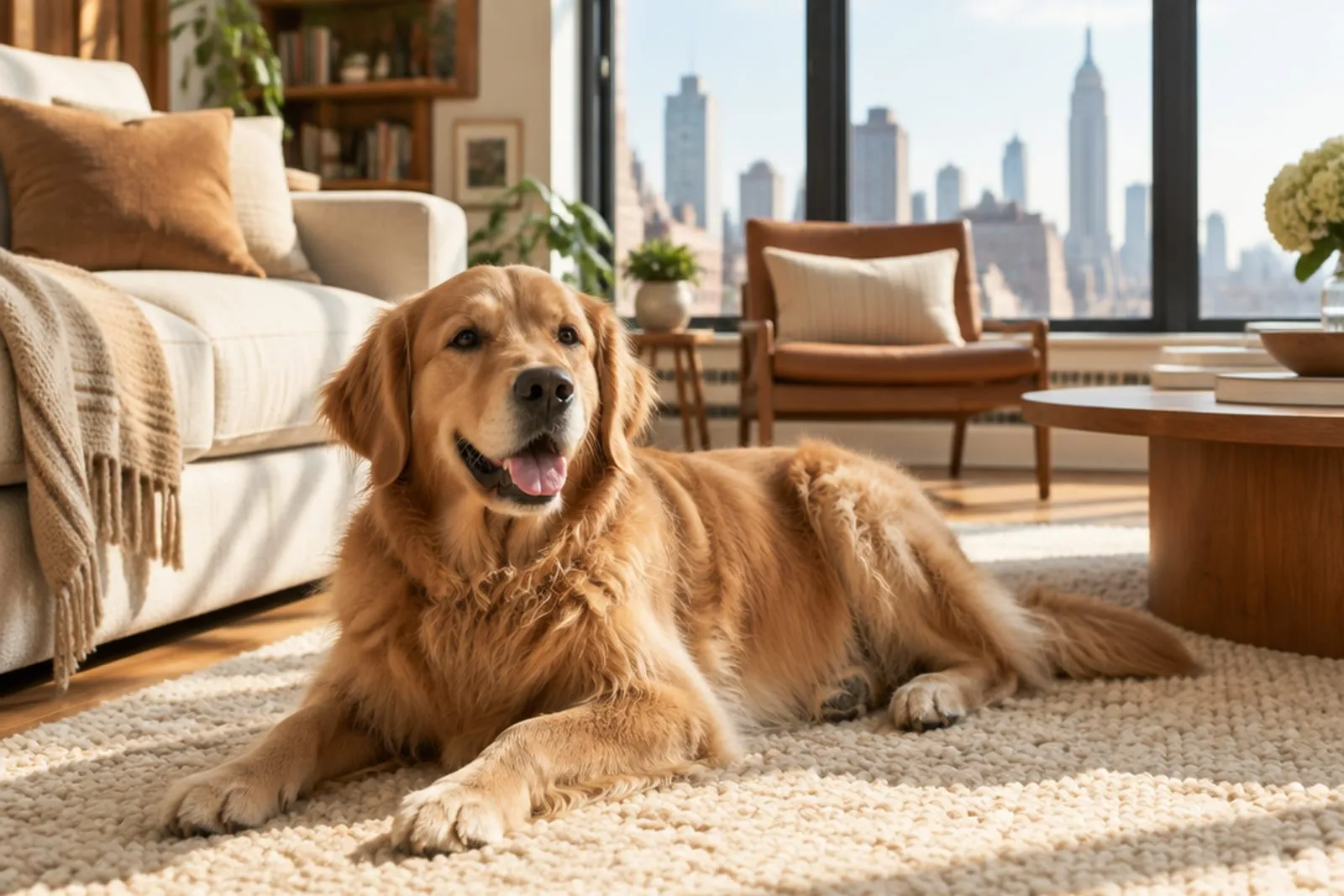
General advice says every three to five years. For a Park Slope household with young children or dogs, every one to two years is realistic, and annually for a living room or dining room rug.
The reason is not the visible spills — those get dealt with as they happen. It is dry grit tracked in from the street and the park, working down into the foundation, where it cuts the fibres every time someone walks across it. That damage is permanent, invisible until the wear shows, and it is the main reason family rugs fail early.
What actually extends a rug's life, for nothing
Worth saying because the common advice is wrong.
The instinct is to buy something cheap because of the children — but wool has natural lanolin that resists liquid absorption, hides soil far better than flat synthetics, and recovers from crushing. It cleans well and lasts decades. A low-pile hand-knotted or hand-tufted wool rug is a better family rug than a cheap polypropylene one, and cheaper over ten years.
Sold as art silk or bamboo silk, it fails permanently on contact with water — including water from a spill or an over-enthusiastic clean-up. It is the wrong material for a house with a toddler.
Shag and deep pile trap food, crumbs, and grit, and take far longer to dry when something is spilled.
Obvious, but people forget it until after the purchase.
It stops the rug sliding, cushions impact, and — importantly — lets air circulate underneath so spills that soak through can dry.
Honestly: useful in the right place, oversold everywhere else. Machine-washable rugs are thin polyester, genuinely convenient under a high chair or in a nursery, and worth having there. They are not durable, they do not feel like wool, and they will not last. Buy one for the spot where accidents actually happen, not for the living room.
Park Slope is the largest landmarked neighborhood in New York — the Park Slope Historic District was designated in 1973, extended south in 2012 and north in 2016, and covers roughly 2,575 buildings across about forty blocks. Predominantly late nineteenth-century brownstones and limestones, with the Victorian mansions of the Prospect Park West "Gold Coast" dating from the 1880s and 1890s.
Access is straightforward but physical: a stoop, an internal staircase, usually no elevator or doorman. You need to be home for pickup and delivery, and you should give your floor and mention any tight staircase turns when you request a quote, so a stair carry is priced upfront rather than renegotiated at your door.
Garden-level and duplex apartments in converted houses have direct backyard access — convenient for pickup, and the source of a good deal of the mud.
Certificates of insurance are rarely needed here. Owner-occupied houses generally have no vendor process at all; check with management only if you are in a co-op or a newer building on Fourth Avenue.
The neighborhood's most-needed service. Immersion at a plant, never surface treatment.
The family staple. In-plant, pH-neutral.
Priced per spot, typically $20 to $50 each. Point them out at pickup rather than hoping they are noticed.
Edges fray at doorways and stair runners wear at the nosing. Binding and serging is cheap relative to replacement.
| Rug type | Per sq ft | 8×10 (80 sq ft) | 9×12 (108 sq ft) |
|---|---|---|---|
| Synthetic | $3 – $6 | $240 – $480 | $324 – $648 |
| Wool | $4 – $7 | $320 – $560 | $432 – $756 |
| Persian / Oriental | $5 – $8 | $400 – $640 | $540 – $864 |
Minimum service charge is $150 to $250, most companies include free pickup and delivery, and add-ons run roughly $20 to $50 per stain and $30 to $100 per pet-urine area. Full breakdown on the rug cleaning cost calculator.
Send several rugs together and you pay one minimum rather than several — the arithmetic is on the Brooklyn page.
Compare the same job, not three different scopes
Describe the rug or rooms, access and treatments once, then compare written, all-in quotes.
Local pricing
The rate card is the same everywhere in Brooklyn. What moves your total in Park Slope is the building it comes out of.
Stair, minimum and access figures are the citywide ranges from the RugRate price reference, not quotes from any company.
11215 and 11217, covering Park Slope from Prospect Park West across to Fourth Avenue, between Flatbush Avenue and the Prospect Expressway.
Blot it immediately with a clean white cloth — press down and lift, never rub — and use cold water only. Milk is a protein, and hot water cooks proteins into the fibre and sets the stain permanently. Even blotted well, milk can smell later as it breaks down, so if it soaked through it is worth having treated with an enzyme cleaner professionally rather than hoping.
You generally cannot at home, and that is not a failure of effort. Urine salts stay chemically active in the rug's foundation and draw moisture from the air, releasing odour indefinitely — which is why a spot that seemed fixed smells again on a humid day. It has to be flushed out by full immersion at a plant. Say whether it was cat or dog when you book, and roughly how long ago, since cat urine is more concentrated and harder to remove.
Yes, noticeably. It is more concentrated, higher in uric acid, and the odour is far more persistent. A cat will often return to the same spot because it can still smell it, so proper treatment is what breaks the cycle. Dog urine carries a different risk: it is alkaline enough to strip dye from wool, leaving a pale patch that may be permanent if left for months.
Let it dry completely, then vacuum. Every instinct says clean it while wet, but wet mud smears into the pile and drives deep, while dried mud crumbles and comes out almost entirely. This is the single most useful thing to know in this neighborhood.
Every one to two years, and annually for a living room or dining room rug — more often than the usual three-to-five-year advice. The reason is not the spills but the dry grit tracked in from the street and the park, which works into the foundation and cuts the fibres permanently. Vacuum slowly and in both directions twice a week in between; it does more than any product.
Low-pile wool, contrary to the usual instinct to buy something cheap. Wool's natural lanolin resists liquid, it hides soil better than flat synthetics, it recovers from crushing, and it cleans well and lasts decades — cheaper over ten years than replacing cheap polypropylene. Avoid viscose entirely, since it fails permanently on contact with water. Choose a pattern and a mid-tone, and use a proper pad.
In the right spot, yes. They are thin polyester, genuinely convenient under a high chair or in a nursery, and worth having exactly there. They are not durable and will not last like wool, so buy one for where accidents actually happen rather than for the living room.
Usually, yes, but leave it alone until a professional sees it. Crayon is wax, and scrubbing spreads it and pushes it deeper. It needs solvent treatment, which is a professional job — and attempting it with a household cleaner often strips dye around the mark.
Brooklyn rates, which are the best value in the city: roughly $4 to $7 per square foot for wool and $5 to $8 for Persian or Oriental, with a $150 to $250 minimum. An 8×10 wool rug typically runs $320 to $560. Stain treatment adds about $20 to $50 per spot and pet urine treatment $30 to $100 per area.
No. The Park Slope Historic District constrains exterior work on the houses, but the Landmarks Preservation Commission does not regulate taking a rug out and bringing it back.