
Carpet cleaning · Manhattan
Carpet Cleaning in Manhattan
Carpet cleaning in Manhattan is the same work as carpet cleaning anywhere else, done under a constraint that exists almost nowhere else: the van cannot park outside your building, and the machine that does the best work never comes indoors.
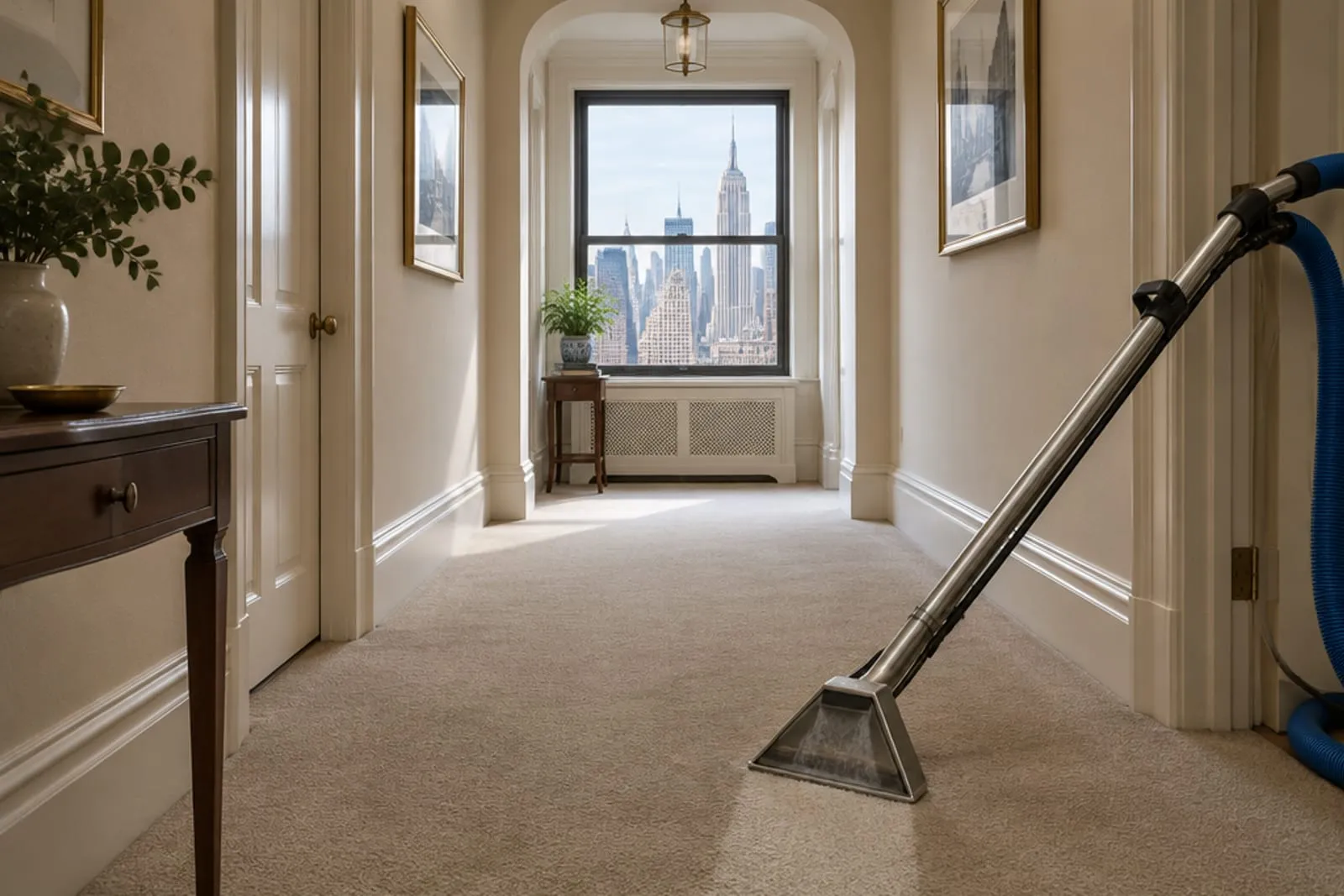
Everything on this page follows from that. What the four methods actually are, which of them suits a pre-war walk-up versus a doorman tower, why the same job is quoted differently by two companies, and the one question worth asking before you book anything.
If you already know what you need, get quotes. If you want to know which companies serve your building and how the certificate-of-insurance process works, that is on the Manhattan directory page.
What Carpet Cleaning Costs in Manhattan
| Service | Typical price |
|---|---|
| Per square foot | $1–4 |
| Per room | $50–150 |
| Stairs | $2–5 per step, or $30–80 per flight |
Manhattan sits at the top of those ranges, and often at a minimum instead.: Three reasons, all of them legitimate
- Access time
A job that takes ninety minutes of cleaning can take another ninety of hose runs, elevator waits and protecting common areas.
- Minimums
A single bedroom of carpet is almost always priced at the company's minimum job charge rather than by area, because the trip and the setup cost the same regardless.
- Building administration
Certificates of insurance, service-entrance scheduling and freight elevator windows all take somebody's time.
Two figures worth asking about separately, because they are frequently not in the first number quoted: furniture moving (some companies include light furniture, almost none include heavy pieces or anything with contents), and stairs, which are always priced separately and always by the step or the flight.
The Manhattan Problem: Will the Hose Reach?
This is the section that could not have been written about anywhere else, and it is the most useful thing on the page.
Why a truck-mount is better, and why you may not get one
A truck-mounted unit lives in the van. It generates its own heat and its own vacuum, both far beyond anything a portable machine can produce, and it delivers them to the apartment through a hose. More vacuum means more of the water that went down comes back up, which means a cleaner carpet and a faster dry. It is the better machine and it is not close.
In a suburb, the van parks in the driveway and the hose runs twenty feet. In Manhattan
- There is usually nowhere legal to park outside the building.
- The hose has to run from wherever the van actually stopped, through a service entrance, into a freight elevator, along a corridor, and into your apartment.
- Vacuum and heat both fall off with distance, and vertical lift costs vacuum specifically. A hose run that is fine at fifty feet is a different machine at two hundred feet and fourteen floors up.
- Some buildings simply will not permit a hose run through common areas, or will permit it only in a narrow service window.
So the honest position: a truck-mount is better, and in Manhattan you frequently cannot have one working at its best, or at all.
When a portable is the right answer
A portable extractor is carried into the apartment and plugged in. Less vacuum, less heat, and a tank that has to be filled and emptied.
It is also, in a lot of Manhattan buildings, the only machine that can physically get to your carpet — and a good operator with a portable beats a rushed truck-mount job every time. What matters is extraction, and extraction with a portable is a function of technique: slow passes, many more dry passes than wet ones, frequent tank changes, and patience.
The thing to ask is not "do you have a truck-mount." It is:
"Which machine will you actually be using in my apartment, and how many dry passes do you do?"
A company that answers that specifically is a company that has thought about it.
What to tell them when you book
Say all of this at booking, not at the door
- Your floor number, and whether there is a freight elevator.
- Whether the building requires a certificate of insurance — most Manhattan buildings do, it takes a day or two to issue, and it is the single most common reason a job gets postponed on the morning. The COI process is explained here
- The building's service hours, which are often 9 to 4 on weekdays only.
- Where a van can realistically stop, if you know.
- How many rooms, and whether there are stairs.
- What furniture needs moving, and what is too heavy or too full to move.
A company told all six quotes accurately and turns up able to work. A company told none of it either reschedules or renegotiates in your hallway.
Drying, in an Apartment
Manhattan apartments dry badly. They are often single-aspect, frequently have windows that open onto an airshaft, and in summer the outdoor air is more humid than the indoor air.
- Expect 6 to 12 hours to dry to the touch after hot-water extraction, and up to 24 to be thoroughly dry. One to two hours after encapsulation.
- Run the air conditioning rather than opening the windows on a humid day. An air conditioner removes moisture from indoor air; an open window on a muggy August afternoon adds it.
- Move air across the carpet, not down at it, and leave interior doors open.
- Keep furniture off it until it is properly dry, or put foil or plastic tabs under the legs — wooden legs and metal feet on damp carpet leave marks worse than whatever was cleaned.
- Walk on it as little as possible while damp.
Carpet that is still damp at 24 hours, smells musty a few days later, or develops a stain that reappears is a specific and well-understood set of problems — all three are explained here.
Compare the same job, not three different scopes
Describe the rug or rooms, access and treatments once, then compare written, all-in quotes.
Companies Serving Manhattan
Compare companies that cover your area, then ask for written quotes on the same scope.
On the main page
Methods, Frequency, Preparation and Drying
The five-step process, the four cleaning methods, how often carpet needs cleaning and how to prepare are all on the carpet cleaning page.
Carpet Cleaning in Manhattan — FAQs
Is steam cleaning the same as hot-water extraction?
Yes, and the popular name is misleading. There is no steam involved — hot water is injected under pressure and immediately vacuumed back out, carrying suspended soil with it. Hot-water extraction is the industry standard because it cleans the full depth of the pile, and it is the method most carpet manufacturers specify in their warranty terms.
Which carpet cleaning method is best?
For residential carpet, hot-water extraction, unless drying is a genuine problem. Encapsulation is a good maintenance method and dries in one to two hours, which makes it a reasonable trade in a poorly ventilated apartment or a space that cannot close. Dry compound suits offices that cannot be out of use. Bonnet cleaning cleans the top of the pile only and should not be sold as a deep clean.
Is bonnet cleaning any good?
For appearance-level maintenance, yes — it is why hotels use it between guests. As a deep clean, no. It works on the top of the pile, can fuzz or distort cut-pile fibre tips, and tends to push soil down rather than remove it. If one quote is far below all the others, ask which method it includes.
Do carpet cleaners vacuum first?
The good ones do, and it is the most informative question you can ask. Most of what is in a carpet by weight is dry particulate soil, and dry soil comes out dry — add water first and it becomes mud, which is far harder to extract. A cleaner who wets an unvacuumed carpet has made the job worse.
Truck-mount or portable — which should I ask for in Manhattan?
Ask the better question: which machine will actually be used in your apartment, and how many dry passes they do. A truck-mounted unit is the stronger machine, but in Manhattan the hose has to run from wherever the van could stop, through a service entrance and freight elevator to your floor — and both vacuum and heat fall off with distance and vertical lift. A good operator with a portable, working slowly with plenty of dry passes, beats a rushed truck-mount job.
How long does carpet take to dry after cleaning in an apartment?
Six to twelve hours to dry to the touch after hot-water extraction, up to 24 to be thoroughly dry; one to two hours after encapsulation. On a humid day close the windows and run the air conditioning, which removes moisture, rather than opening windows and letting more in.
Does my carpet warranty require professional cleaning?
Frequently, yes. Many manufacturers require periodic professional hot-water extraction and ask for receipts as proof. Read your warranty before choosing a cheaper method — it is a common and expensive thing to discover afterwards.
Does my building need a certificate of insurance?
Most Manhattan buildings do. It takes a day or two to issue and it is the single most common reason a booking is postponed on the morning of the job. Ask your building's management what they require, and tell the cleaning company at the time of booking rather than the day before.
What does carpet cleaning cost in Manhattan?
Roughly $1–4 per square foot or $50–150 per room, with Manhattan jobs sitting at the top of those ranges and small jobs usually priced at the company's minimum instead. Stairs are quoted separately at $2–5 per step or $30–80 per flight. Ask whether furniture moving is included.